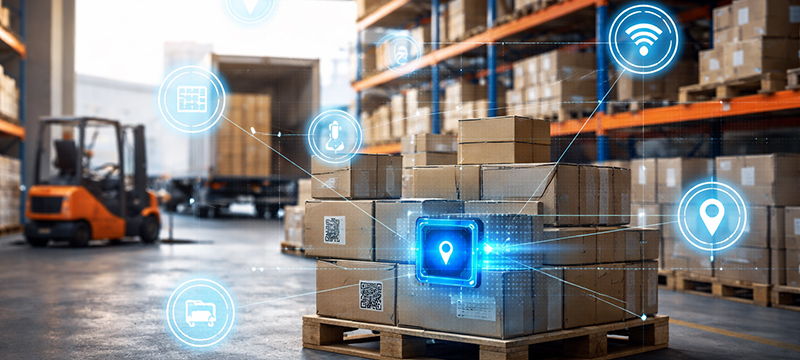
Supply chains have become more complex, global, and data-driven than at any point in recent history. At the same time, disruptions—ranging from geopolitical tensions to operational bottlenecks—have exposed the limits of traditional tracking systems. In this context, Supply Chain Visibility has emerged as a critical capability for organizations seeking to understand, monitor, and manage the movement of goods in real time.
The Internet of Things (IoT) plays a central role in enabling this visibility by connecting physical assets to digital systems. Through sensors, connectivity networks, and data platforms, IoT provides granular insights into location, condition, and status across the supply chain. This article explores how these technologies work together, where they are deployed, and what trade-offs decision-makers need to consider.
Key Takeaways
Supply Chain Visibility relies on IoT to provide real-time tracking and condition monitoring across distributed logistics networks.
A combination of sensors, connectivity technologies, and cloud platforms enables end-to-end data collection and analysis.
Use cases span logistics, industrial operations, healthcare, and energy, with varying technical requirements.
While visibility improves decision-making and resilience, challenges remain around integration, cost, and data standardization.
Future developments will increasingly leverage edge computing, AI, and digital twins to enhance predictive capabilities.
What is Supply Chain Visibility with IoT?
Supply Chain Visibility refers to the ability to track, monitor, and analyze the movement and condition of goods, assets, and processes across the entire supply chain in near real time. When enabled by IoT technologies, this visibility extends beyond location tracking to include environmental conditions, asset utilization, and operational performance.
Within the IoT ecosystem, Supply Chain Visibility connects physical objects—such as pallets, containers, vehicles, or industrial equipment—to digital platforms. These connections allow stakeholders to access actionable data, improving coordination between suppliers, manufacturers, logistics providers, and end customers.
How Supply Chain Visibility with IoT works
IoT-enabled Supply Chain Visibility is built on a multi-layered architecture combining devices, connectivity, data processing, and applications.
At the edge, sensors and tracking devices are attached to assets. These devices collect data such as GPS location, temperature, humidity, shock, or motion. Depending on the use case, they may operate continuously or intermittently to optimize battery life.
Data is transmitted via communication networks to centralized or distributed platforms. These networks can include cellular IoT (LTE-M, NB-IoT), LPWAN technologies (LoRaWAN, Sigfox), satellite connectivity, or short-range protocols like Bluetooth and Wi-Fi.
Once collected, data is processed in cloud or edge environments. Platforms aggregate and normalize data from multiple sources, enabling analytics, visualization, and integration with enterprise systems such as ERP or transportation management systems.
Applications then present insights to users through dashboards, alerts, and APIs. These tools support operational decisions, such as rerouting shipments, adjusting inventory levels, or responding to anomalies.
Key technologies and standards
Supply Chain Visibility depends on a combination of hardware, connectivity, and software technologies.
Sensors and devices: GPS trackers, temperature sensors, accelerometers, and environmental monitors.
Connectivity technologies: Cellular IoT (LTE-M, NB-IoT), LPWAN (LoRaWAN), satellite IoT, Bluetooth Low Energy (BLE), Wi-Fi.
Communication protocols: MQTT, CoAP, HTTP for data transmission between devices and platforms.
Edge computing: Local data processing to reduce latency and bandwidth usage.
Cloud platforms: Data ingestion, storage, analytics, and integration layers.
Standards and frameworks: GS1 standards for supply chain data, EPCIS for event sharing, and emerging interoperability frameworks.
The choice of technologies depends on factors such as coverage requirements, power consumption, data frequency, and cost constraints.
Main IoT use cases
IoT-enabled Supply Chain Visibility is applied across multiple industries, each with specific operational requirements.
Logistics and transportation: Real-time tracking of shipments, fleet monitoring, and route optimization.
Industrial IoT: Monitoring of raw materials and components across manufacturing supply chains.
Cold chain logistics: Continuous temperature monitoring for pharmaceuticals and perishable goods.
Healthcare: Tracking of medical equipment and sensitive biological materials.
Energy and utilities: Monitoring of equipment and spare parts across distributed infrastructure.
Smart cities: Management of urban logistics, waste collection, and public asset tracking.
In each case, the level of visibility required varies. Some applications focus on periodic updates, while others demand continuous, real-time monitoring.
Benefits and limitations
IoT-driven Supply Chain Visibility offers several advantages but also introduces technical and operational challenges.
Benefits:
Improved operational efficiency through real-time insights.
Enhanced risk management and disruption response.
Better inventory optimization and reduced waste.
Increased transparency for stakeholders and customers.
Support for compliance and regulatory requirements.
Limitations:
Connectivity gaps in remote or indoor environments.
Battery life constraints for tracking devices.
Integration complexity with legacy enterprise systems.
Data fragmentation across multiple stakeholders.
Cost considerations for large-scale deployments.
Balancing these factors requires careful system design and alignment with business objectives.
Market landscape and ecosystem
The ecosystem supporting Supply Chain Visibility spans multiple layers and stakeholders.
Device manufacturers develop sensors and tracking hardware tailored to specific industries. Connectivity providers offer network access through cellular, LPWAN, or satellite technologies. Platform vendors deliver data management and analytics capabilities, often integrating with enterprise applications.
System integrators and solution providers play a key role in assembling these components into operational systems. In parallel, standards organizations and industry consortia work to improve interoperability and data sharing across supply chains.
This fragmented landscape reflects the diversity of use cases and the absence of a single dominant architecture.
Future outlook
Supply Chain Visibility is expected to evolve alongside broader IoT and digital transformation trends. Edge computing will enable faster, localized decision-making, particularly in environments with limited connectivity.
Artificial intelligence and machine learning will enhance predictive capabilities, allowing organizations to anticipate disruptions rather than react to them. Digital twins—virtual representations of supply chains—will provide simulation and optimization tools.
At the same time, increasing attention is being paid to data governance, security, and interoperability. As supply chains become more interconnected, the ability to share trusted data across organizational boundaries will become a critical factor.
Frequently Asked Questions
What is Supply Chain Visibility in IoT?
It is the ability to monitor the location, condition, and status of goods and assets across the supply chain using connected devices and data platforms.
How does IoT improve Supply Chain Visibility?
IoT enables real-time data collection through sensors and tracking devices, providing insights that were previously unavailable or delayed.
What technologies are used for Supply Chain Visibility?
Technologies include sensors, GPS tracking, cellular IoT, LPWAN networks, cloud platforms, and data analytics tools.
What are the main challenges?
Challenges include connectivity limitations, integration with existing systems, device power management, and data interoperability.
Is Supply Chain Visibility only about tracking location?
No, it also includes monitoring environmental conditions, asset performance, and operational processes.
Related IoT topics
Asset Tracking in IoT
LPWAN Connectivity for IoT
Edge Computing in Industrial IoT
Cold Chain Monitoring
Digital Twins for Supply Chains
IoT Data Platforms and Analytics
The post Supply Chain Visibility with IoT: Tracking, Monitoring and Resilience appeared first on IoT Business News.