The New York Times recently reported on a new research paper that finds that, as summarized by the Times, “the North American Free Trade Agreement and trade competition with Mexico led to earlier deaths for American factory workers.”
Specifically, the researchers found that, from NAFTA’s launch in January 1994 through 2008, mortality increased in those “commuting zones” in the continental United States that had a disproportionately large number of workers producing manufactured goods in competition with imports from Mexico. Especially hard hit in those commuting zones were men who, in 1994, were ages 25 to 44. Losing jobs as a result of the greater freedom of Americans to purchase imports from Mexico, manufacturing workers and members of their households in these hard-hit commuting zones became more likely to commit suicide, turn to drugs or alcohol, or otherwise suffer ill health that raised their chances of going early to their graves.
In short, NAFTA was deadly because NAFTA destroyed manufacturing jobs. It’s a tiny leap from this finding to the conclusion that free trade is very likely hazardous to the health of manufacturing workers and their families. And at least one of the paper’s three authors — University of Chicago economist Matthew Notowidigdo — made this leap when he told the New York Times that his research highlights an “underappreciated cost of globalization.”
The econometrics in the paper is genuinely impressive. I assume that the finding of increased mortality is accurate. But I dispute the conclusion that this rise in mortality can legitimately be said to be the result of the freeing of trade.
NAFTA Job Losses Compared to Total Job Losses
Let’s put NAFTA job losses into perspective.
The total number of jobs destroyed by NAFTA from 1994 through 2008 was minuscule compared to total job destruction over those years. The St. Louis Fed has data starting in December 2000 on total monthly layoffs and discharges — that is, for 97 of the 180 months covered by Notowidigdo, et al’s research. During those 97 months, an average of 1.9 million workers in America every month lost or were laid off from jobs they wanted to keep.
How much of this job destruction was caused by NAFTA? The Economic Policy Institute — an outfit hostile to NAFTA — estimates that over the course of NAFTA’s first 20 years, it destroyed a total of 700,000 jobs. Even assuming that all of those 700,000 jobs were destroyed in NAFTA’s first 15 years, that’s an average monthly job loss of only 3,900 — or 0.2 percent of the average total monthly layoffs and discharges during this period.
This picture hardly changes if we compare NAFTA job losses to only manufacturing-worker layoffs and discharges. On average, 194,000 manufacturing workers lost their jobs each and every month from December 2000 through December 2008. NAFTA job losses, therefore, were a mere 2.0 percent of all manufacturing-job losses in those years. Ninety-eight percent of manufacturing-job losses from December 2000 through December 2008 were caused by forces other than NAFTA.
NAFTA Job Losses Compared to Earlier-Era Losses of Manufacturing Jobs
The nationwide rate of manufacturing-job loss from 1994 through 2008 — the years studied by Notowidigdo, et al. — was lower than the nationwide rate of manufacturing-job loss before NAFTA was implemented. Specifically, from 1958 through 1980, each month, on average, 1.6 percent of manufacturing workers were laid off. Yet from 1994 through 2008, on average only 1.3 percent of manufacturing workers were discharged or laid off. (I calculated this 1.3 percent average monthly rate of manufacturing-worker job loss using available data.) Although there are no data on manufacturing-job losses from 1981 through 1993, the comparison of 1994-2008 with 1958-1980 is nevertheless revealing because it shows for an earlier long span of years a notably higher rate of manufacturing-job loss than occurred during the first 15 years of NAFTA, thereby putting the experience of the first 15 years of NAFTA into some meaningful historical context.
If it’s true that NAFTA’s destruction of manufacturing jobs resulted in an unusually high rate of mortality among manufacturing workers, it should also be true that manufacturing workers in those pre-NAFTA years were even more likely than were manufacturing workers in the years with NAFTA to commit suicide, turn to drink or drugs, or otherwise fall into life-draining despair.
Were they? I searched hard for evidence from that earlier era on the mortality linked to job losses of manufacturing workers, but (even with the help of AI) found none. Yet I’ve also never encountered any claims that manufacturing workers in the years 1958 through 1980 were unusually likely to suffer “deaths of despair” and other life-shortening calamities. The absence of barking by this particular dog is especially telling given that, compared to the NAFTA years, both the absolute number of manufacturing workers, as well as manufacturing employment’s share of total employment, were higher in those earlier years. My tentative conclusion, therefore, is that the blame for the increased mortality identified by Notowidigdo, et al., lies with something other than the loss of manufacturing jobs — and, hence, with something other than NAFTA. (I call my conclusion “tentative” because it’s possible that someone will uncover evidence from those pre-NAFTA years of high manufacturing-worker mortality — specifically, high mortality linked to job losses. But, again, I know of no such evidence.)
What If Manufacturing-Job Loss DOES Increase Mortality?
Let us, however, assume for the moment that evidence is uncovered showing that, in those pre-NAFTA years, mortality linked to job losses of manufacturing workers was indeed unusually high. Would such evidence salvage Prof. Notowidigdo’s conclusion that the rise in mortality reported in his paper is a “cost of globalization”?
No.
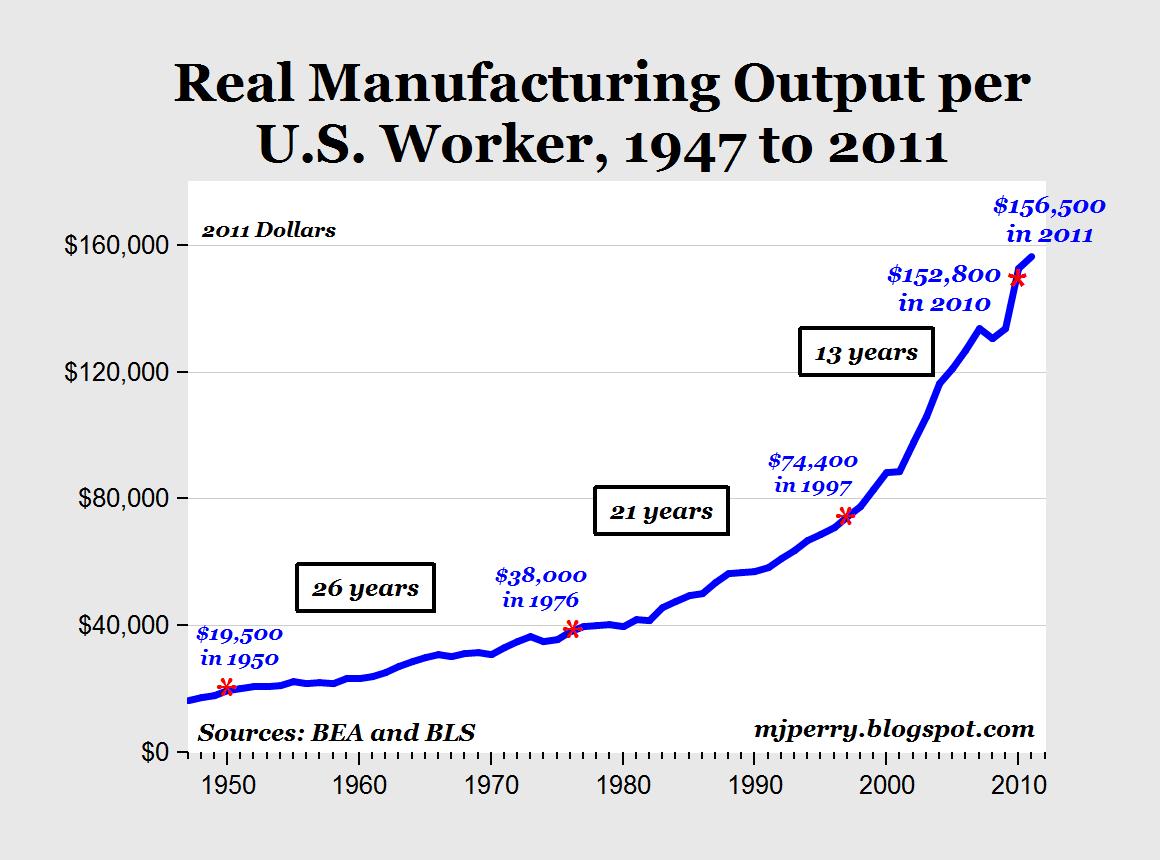
The reason is that the US economy in those earlier years was much less exposed to foreign competition than it was during the NAFTA years. (Each year from 1958 through 1980, US goods imports averaged 1.8 percent of GDP, while each year from 1994 through 2008, US goods imports averaged 4.6 percent of GDP.) Those earlier manufacturing-job losses were due overwhelmingly to rising productivity. Between 1958 and 1980, real output per manufacturing worker in the US doubled — a major reason why manufacturing employment as a share of total private-sector employment fell over those years from 34 percent to 25 percent (calculated by dividing total manufacturing employment by total private-sector employment). Even with NAFTA in place, rising worker productivity continues to be the chief source of manufacturing-job loss — accounting, according to Michael Hicks and Srikant Devaraj, for nearly 88 percent of such job losses from 2000 through 2010.
Even if manufacturing-job loss can legitimately be said to cause unusually high mortality among manufacturing workers, trade is only one source of such job loss, and a relatively minor source at that. Therefore, if one is to classify globalization as a cause of higher-than-usual mortality among manufacturing workers, one must also classify, as an even more significant cause of this mortality, labor-saving technology — and, indeed, any source of manufacturing-job loss.
Under these circumstances, singling out globalization as a source of unusually high mortality is not only misleading, but counterproductive. Doing so focuses the public’s and policymakers’ attention on a relatively insignificant source of avoidably high mortality while ignoring the chief source: rising worker productivity. If the loss of manufacturing jobs raises mortality — and if the government is intent on ensuring that manufacturing workers don’t fall into early graves — the government must prevent not only increased imports of manufactured goods, but also, and far more importantly, increases in manufacturing-worker productivity.
What politician or pundit will openly endorse such a policy?
Fortunately, in fact, there is no evidence that the productivity-driven loss of manufacturing jobs in the past caused a rise in mortality. And so because even today freer trade destroys far fewer manufacturing jobs than do improvements in worker productivity, it’s almost certainly incorrect to blame the job losses due to freer trade generally, and to NAFTA specifically, for any measured increases in manufacturing-worker mortality.
Whatever the Cause(s) of Higher Mortality, Free Trade Isn’t to Blame
So what are the likely causes of the rising mortality detected by Notowidigdo, et al.? To answer this question requires, as they say, further study. There are several candidates, however, of varying plausibility. These include:
Increased access to public and private welfare which enables people who lose jobs to remain unemployed longer, perhaps undermining their sense of self-worth.
Readier access to debilitating drugs, or reduced social stigma from using such drugs.
Increased occupational-licensing requirements which obstruct unemployed workers’ efforts to pursue new occupations.
The rise in land-use restrictions which raise the cost of moving to new locations with better job prospects.
A cultural change that either made the loss of manufacturing jobs more shameful than were such losses prior to NAFTA, or that drained unemployed manufacturing workers of the gumption possessed by previous generations of unemployed workers to actively search for new jobs.
Whatever the actual cause (or causes) of the rise in mortality, blaming NAFTA is incorrect given that it is only one of countless sources of job destruction, and a rather minor source. Even worse is leaping from a finding of rising manufacturing-worker mortality during NAFTA’s first 15 years to the conclusion that, for manufacturing workers generally, globalization is lethal.