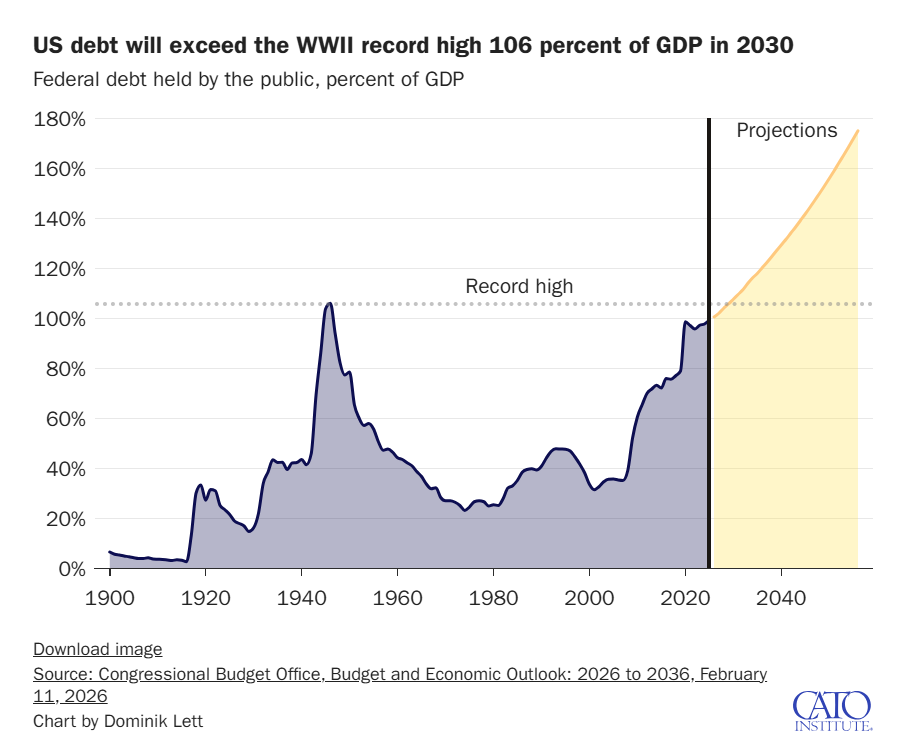
US public debt has reached 100 percent of GDP (gross domestic product) for the first time since the aftermath of World War II. Just because we have been here before, and we managed, doesn’t mean we will do so again. This time is different in important ways that are underappreciated by both policymakers and the public.
In 1946, the United States emerged from a global war with high debt, but also with a young population, strong growth prospects, and a political commitment to fiscal restraint. Today, America faces the opposite: an aging population, structurally rising entitlement spending, and persistent deficits with no credible plan to rein them in.
After World War II, crossing the 100 percent threshold marked a turning point. Debt peaked at 106 percent of GDP and then declined rapidly as growth surged and spending fell. This time, crossing the threshold reflects the opposite dynamic: not the end of a temporary emergency, but the continuation of a multi-decade spending and debt binge, driven by unsustainable entitlement promises.
Do Debt Thresholds Matter?
Economists have long debated whether there is a specific tipping point at which public debt begins to harm economic growth. While estimates vary, a broad body of research suggests that the risks become more pronounced as debt rises beyond roughly 80 percent of GDP for advanced economies. Sustained debt levels above this range are associated with slower economic growth, reduced investment, and diminished fiscal flexibility.
The United States has now moved well beyond the range where research suggests debt begins to weigh on growth. High debt levels gradually erode economic performance through crowding out private investment, increasing borrowing costs, and limiting the government’s ability to respond to future crises.
The United States is also different from other advanced economies due to the unique role that the US dollar plays in global financial markets. As the issuer of the world’s dominant reserve currency and a primary supplier of safe assets, the US benefits from what economists call an “exorbitant privilege.” This enables the US government to sustain higher debt levels than other countries.
Even this privilege is not without limits, however. Estimates suggest that the dollar’s status may expand the US government’s debt capacity by roughly 20 percent of GDP, putting the US threshold where debt begins to weigh on growth closer to 100 percent of GDP than 80.
And “exorbitant privilege” is not a permanent entitlement, either. It depends on investor confidence, the depth and liquidity of US financial markets, and the absence of credible alternatives to US dollar dominance. Should that confidence weaken, because of political dysfunction, fiscal irresponsibility, and the rise of competing safe assets, the US advantage could erode.
Counting on privilege as a substitute for discipline is a risky strategy. And allowing higher debt to depress economic potential reduces long-term income growth and Americans’ opportunities.
Unsustainable Debt Growth
US debt is not just high, it is on a steep and unsustainable trajectory. Under current policies, federal debt is projected to continue rising indefinitely, reaching levels that would have been unthinkable the last time the US enjoyed a budget surplus in fiscal year 2000.
The primary drivers are well known: the growth in Social Security, Medicare, and Medicaid, combined with rising interest costs, accounts for the overwhelming share of future debt increases.
Penn Wharton Budget Model projections show debt approaching 190 percent of GDP in fewer than 20 years, by 2050, at which point markets may no longer be willing to absorb additional Treasury borrowing at any price. According to congressional testimony by Penn Wharton Budget Director, Dr. Kent Smetters: “Without major changes to current US fiscal policy, […] the US government will have to default explicitly by not making interest payments, or default implicitly, through debt monetization (inflation), or some combination.”
Debt that exceeds a country’s economy and is on an upward trajectory signals to investors, businesses, and households that fiscal policy is adrift. Borrowing has become the default, rather than the exception.
A vicious cycle can ensue. As debt rises, interest costs consume a growing share of federal revenues, leaving less room for productive investments and increasing pressure for further borrowing. Higher interest rates can accelerate this dynamic, creating a feedback loop that is difficult to reverse, where higher debt drives up interest rates, which drive up the need for further borrowing.
Already, the federal government spends more on servicing the debt than on protecting the nation against foreign threats. The United States debt is the single greatest threat to our national security.
The Cost of Complacency
The greatest risk posed by crossing 100 percent of GDP is not immediate crisis. It is complacency.
The absence of a clear tipping point makes it easy for the government to rationalize continued borrowing. If 80 percent did not trigger a crisis, why worry about 100? If 100 is manageable, why not 120? When legislators are unwilling to course correct unless the country hits a fiscal cliff, a fiscal crisis becomes a question of not if, but when.
History shows that fiscal crises rarely arrive with advance warning. They tend to emerge suddenly, when investor sentiment shifts and borrowing costs spike. Countries that believed they had ample fiscal space often discover, too late, that their margin for error has vanished.
Crossing 100 percent of GDP should serve as a wake-up call, not because it marks a precise tipping point, but because it signals that the United States is on an unsustainable fiscal path. Even absent an immediate fiscal crisis, legislators should slow the growth in the debt, because high and rising debt carries real economic costs, and those costs grow over time.
The United States still has time to stabilize its fiscal path. But delay will only raise the cost, and increase the risk that inevitable adjustments come through crisis rather than choice.