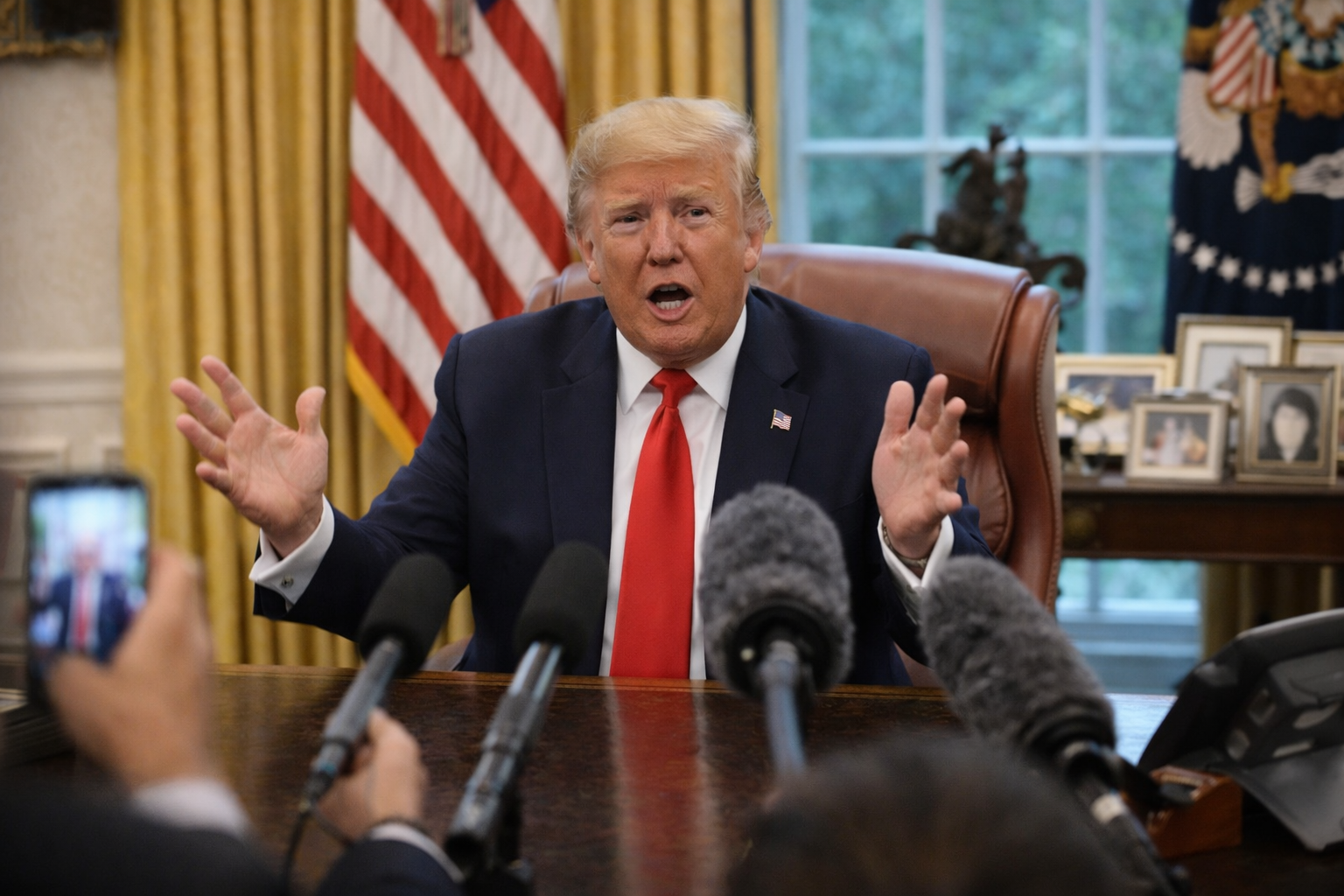
A year ago, Donald Trump called it Liberation Day.
Today, 330,000 American businesses are filing to get their money back, and the President is on television telling them not to.
The refund portal opened on April 20, 2026. By that point, the Supreme Court had already ruled 6-3 that Trump’s signature trade policy was unconstitutional.
What followed is one of the stranger episodes in modern American economic history: a government simultaneously required by court order to refund $166 billion, and a president publicly lobbying companies to leave that money on the table.
How this started and who actually paid?
On April 2, 2025, “Liberation Day,” Trump announced sweeping country-by-country levies under the International Emergency Economic Powers Act, plus a 10% global baseline on virtually all imports.
The stated logic was that foreign countries would bear the cost.
The data demolished that claim almost immediately.
The New York Federal Reserve tracked the burden through the year. From January through August 2025, US importers absorbed 94% of tariff costs.
By November, foreign exporters had adjusted slightly, but US firms and consumers were still on the hook for 86%.
The National Bureau of Economic Research put the total domestic burden at 94%, the Kiel Institute said 96% and AlixPartners, which works directly with corporate supply chains, found that 80-85% of all tariff costs were absorbed domestically, either by companies swallowing the hit, passing it to customers, or some combination of both.
The Tax Foundation estimates the 2025 tariffs amounted to a $1,000 average tax increase per US household.
Yale’s Budget Lab put the GDP growth drag at 0.5 percentage points for the year.
Jerome Powell stated in March 2026 that tariffs were adding between half and three-quarters of a percentage point to inflation.
The largest US tax increase as a share of GDP since 1993, and the burden fell almost entirely on American businesses and the people who shop at them.
The corporate damage, by name and number
The automotive sector took the sharpest blow.
Tariffs on imported vehicles and parts have cost the industry $35.4 billion since their implementation, according to financial filings analysis.
GM, Ford, and Stellantis alone absorbed a combined $6 billion in 2025.
Toyota projected a $9.5 billion impact on its US operations for the fiscal year.
Retail was next. Gap estimated the tariff hit at $100-150 million.
Levi Strauss paid enough in duties on denim and apparel imports that its CFO publicly confirmed an expected $80 million refund.
McCormick warned investors that tariffs could cost $70 million in a single fiscal year because black pepper, cinnamon, and vanilla come from exactly the countries Washington decided to target.
Many firms delayed the consumer impact by selling through pre-tariff inventory, pricing goods based on what they paid before Liberation Day rather than what imports cost after.
That buffer ran out by year-end.
By late 2025, the Council on Foreign Relations found Americans were bearing tariff costs at rates as high as 100% for many consumer durable goods.
The SC ruling and the $166 billion question
On February 20, 2026, the Supreme Court ruled 6-3 that IEEPA does not authorise the president to impose tariffs.
The majority opinion was that the power to impose tariffs is a branch of the taxing power, and that belongs to Congress under Article I of the Constitution.
Every tariff imposed under IEEPA, including the Liberation Day levies and all country-specific reciprocal duties, was declared invalid from the moment it was first collected.
Penn Wharton projects total refunds could reach $175 billion.
CBP estimates $166 billion across 53 million shipments from more than 330,000 importers.
The refund portal, called CAPE, went live on April 20 and processes claims electronically within 60-90 days of acceptance.
Although the portal opened just days ago, as of April 14, only 56,497 importers had completed the bank registration required to receive payment, meaning the majority of eligible companies hadn’t even taken the first step toward collecting money legally owed to them.
“I’ll remember them”
A day after the portal opened, Trump appeared on CNBC’s Squawk Box.
He was asked about Apple and Amazon, two of the most prominent companies that had not filed.
He called it “brilliant” if they chose not to. “I’ll remember them,” he said.
Apple is in active negotiations about US manufacturing commitments and cannot afford to antagonise Washington. Amazon runs one of the largest cloud infrastructure businesses serving the federal government.
For both, filing a legally valid refund claim carries real political cost.
The President was explicitly asking corporations to voluntarily forfeit money a 6-3 Supreme Court said the government illegally collected.
A Citi analysis from April 10 quantifies what is at stake by company.
Walmart is owed an estimated $10.2 billion, Target $2.2 billion, Nike $1 billion, Kohl’s $550 million, Gap $400 million, and Macy’s $320 million.
The shippers, FedEx, UPS, and DHL, all filed on Day 1 and pledged to pass refunds back to customers.
Costco had been fighting since November 2025, filing a federal lawsuit before the Supreme Court even ruled, and has committed to returning money through lower prices.
These companies calculated that the legal and reputational cost of not filing outweighed the political risk.
What this means for investors?
Most companies that reported earnings recently left refund income entirely out of their forward guidance, and that is the right call for now.
The administration has signalled it will contest refunds aggressively.
Trump pivoted to Section 122 of the Trade Act of 1974, the same day the Court ruled, attempting to reconstruct tariff authority through a different legal mechanism, and that is already being challenged in court.
Section 232 tariffs on steel, aluminium, autos, copper, and lumber remain fully intact and are not part of this refund process at all, so the automotive industry’s cost structure has not changed.
The refund, if and when it flows, represents a one-time balance sheet event for retailers. That means potential cash for buybacks, debt repayment, or price reductions.
Investors pricing in refund windfalls before the legal picture settles are getting ahead of themselves.
A trade policy that cost the domestic industry tens of billions, added nearly a percentage point to inflation, and was struck down by the Supreme Court still permanently altered the supply chain landscape.
Companies rerouted sourcing, built new supplier relationships, and restructured procurement. Some of that rewiring is irreversible regardless of what happens in court.
The full cost of Liberation Day will never appear in any refund figure.
The post Why does Trump not want US businesses to claim tariff refunds? appeared first on Invezz