Given the bluster and nonstop chatter of today’s political class, President Calvin Coolidge, or “Silent Cal,” might be viewed as a quaint relic. His ability to pack a lot of rhetorical punch in a few words seems to be lost on our current set of politicos. That’s a shame.
Just as tragically, Washington has completely forgotten the path to prosperity that Coolidge clearly demonstrated. By signing the Revenue Act of 1924, he significantly improved the nation’s capacity for productivity. The particulars of that legislation could serve as a powerful lesson for how governments can get out of the way, minimize their economic footprint, and unleash untold value creation.
While economic development is often viewed as complex, the institutional recipe isn’t. It requires sound money, unhampered property rights, and institutional clarity, coupled with a virtuous and vigorous people, deliberately acting to improve their lot in life. Whatever forms of taxation are imposed, they should be simple and light to prevent the stunting of would-be economic growth. When firms and households know they will keep more of what they earn, they create more economic value. That’s a lesson from the Coolidge era that seems to have been lost.
In our day, the 2017 Trump tax cuts have been hailed as reviving economic growth, but with persistently positive inflation, real GDP growth may be lackluster when all final adjustments are made. Whatever good these tax rate reductions have done, they may eventually raise revenues, but they won’t reduce deficits. Instead, the Congressional Joint Economic Committee reports that for fiscal year (FY) 2025, total tax revenues grew by six percent from the previous year, reaching roughly $5.2 trillion. Spending also rose by four percent, hitting $7.0 trillion. The resulting $1.78 trillion deficit, added to previous debts, brings DC’s total to a staggering $39 trillion.
When revenues grow, but deficits balloon more quickly, this raises the question: Is it even possible for tax rate cuts to lead to reduced annual deficits? In a word, yes. During Coolidge’s administration, budget years finished with persistent surpluses, including the largest ever recorded in FY 1927: $1.1 billion, in non-inflation-adjusted terms. That would equate to roughly $21.5 billion today. While this wouldn’t put much of a dent in the trillions that remain to be repaid — the interest on our debt consumes that sum every seven days — that sort of outcome would at least be a step in the right direction.
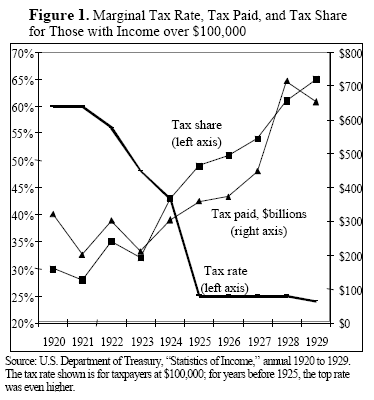
The Revenue Act of ‘24 also went against today’s political grain by lowering the top marginal income tax rate from 73 percent at the beginning of the 1920s to 25 percent. To compensate, the Act also lowered the threshold for paying that 25 percent from $500,000 to $100,000, broadening the tax base. After enactment in 1925, those earning over this amount began contributing a higher share of overall tax receipts.
In fact, when it comes to the share of taxes collected, Coolidge was more progressive than his predecessors. By 1928, over 60 percent of annual income taxes paid came from those earning over $100,000, up from just under 30 percent in 1920 (Table 1, courtesy of Cato.org). Households earning that much in the 1920s would be earning about $1.8 million today, and are subject to a top marginal tax rate of 37 percent. That top rate now kicks in at $640,600 for single filers ($768,700 for married couples filing jointly).
Counter to the prevailing wisdom of our day, taxing more people at lower rates generated more revenue than taxing fewer people at higher rates. In the early 1920s, the top tax rate was 73 percent, but only for those earning $1 million or more (about $19 million today). Both tax rates and their application, led by determinations of how much each income level should contribute, impact total revenues. Indeed, during the 1920s, taxes paid by the poor were slashed. Taxes collected from the poorest Americans had made up 15 percent of total revenue, but that dropped to just over one percent by 1928. Those with “middle-income” status ($10-25,000 annually in 1928, $188-$818,000 today) saw their tax rates fall by over half over the same period (Table 1).
Income tax rates for the poor declined dramatically in the Coolidge period. But today, the lower half of US taxpayers contribute only about three percent of income tax receipts. By contrast, the top 25 percent of income earners contribute over 87 percent of total federal tax revenues. Those in the lowest 20 percent of income earners receive what economists call a negative income tax (Figure 2, courtesy of Cato.org). These households are net recipients of tax revenue, mostly via the earned income tax credit and the child tax credit.
Whenever data points of these sorts are presented, questions are inevitably raised around issues of fairness and who is paying their “fair share.” Rather than small reforms around the edges of tax policy, more radical change is necessary in US fiscal matters. Congress has proven either unwilling or unable to get its fiscal house in order. Reducing spending has been made unnecessarily difficult, with automatic spending on entitlements now accounting for roughly two-thirds of the annual budget. So-called “mandatory spending” has come to dominate the federal government’s annual expenditures, growing from about 26 percent of outlays in 1962 to 66 percent by 2023.
Whether one favors abolition of the income tax, something that then-candidate Trump touted on the campaign trail in 2024, a flat income tax, or shifting towards nationwide consumption taxes, the deficit issue will persist as long as a profligate Congress continues to outspend revenues.
To quote another US President, Thomas Jefferson, “I place economy among the first and most important virtues, and public debt as the greatest of dangers to be feared.” He wasn’t wrong. So, if our modern-day politicians won’t take on the personal qualities or heed the pithy wisdom of Silent Cal, and if they continue to ignore the earlier exhortations of eloquent Jefferson, it appears that no matter what tax reforms get made, we are a long way from any semblance of fiscal sanity.