• Economy
  • Investing
  • Editor’s Pick
  • Stock
Keep Over Tradings
Economy

Nuclear Power Needs Realism, Freedom 

by February 27, 2026

What US industry is the most subsidized and regulated by the federal government? If you answered nuclear power, you are correct. 

As a result, the 70-year “Atoms for Peace” program represents the most expensive failure (malinvestment) in US business with a history of uncompleted projects and massive cost overruns, as well as future decommissioning liabilities.  

Still, President Trump is all-in with nuclear, setting a goal of ten new reactors in construction by 2030 and a quadrupling of total US capacity by 2050. Biden was bullish too, and George W. Bush had his turn at a “nuclear renaissance.” Each failed, but in the nuclear space, hope springs eternal. 

Commercial fission began in the 1950s amid government and scientific fanfare. The promise was virtually limitless, emission-free, affordable electricity compared to coal-fired generation. But the technology was experimental and encumbered by a fear of radioactive contamination. Electric utilities and municipalities resisted. It would take open-ended (federal) research and development, insurance subsidies, and free enriched uranium, and rate-base returns under state regulation, to birth nuclear power.  

Scale economies and learning-by-doing were expected by vendors General Electric, Westinghouse, and others. Their turnkey projects guaranteeing cost and delivery, which produced a “bandwagon effect” of new orders in the 1960s, backfired. Almost half of the plant cost had to be absorbed by vendor stockholders. Cost-plus contracts would ensue with captive ratepayers in tow. 

In the 1970s, cost overruns, completion delays, and cancellations marked the end of the nuclear boom. With the Three Mile Island accident in 1979, a regulatory ratchet accelerated. “Federal regulations used to take up two volumes on our shelves,” one participant told Congress. “We now have 20 volumes to explain how to use the first two volumes.” Legalistic, overly prescriptive, retroactive rules now came from adversarial hearings and “the way of the institutions of government.” 

At the same time, turbine engines fueled by oil and natural gas took off. Cogeneration and combined cycle plants set a new competitive standard for nuclear, not only coal. Such technology used far fewer parts and was much more serviceable than a fission plant. 

Today, 94 active reactors produce dependable power to reinforce a grid weakened by intermittent wind and solar. With high up-front capital expense sunk, marginal-cost economics supports their continued operation. But for new capacity, large necessary government subsidies confirm an enduring reality: nuclear fission is the most complicated, fraught, expensive way to boil water to produce steam to drive electrical turbines. 

Hyperbole abounds about new reactor design. Small Modular Reactors (SMRs) are newsworthy, but is a turnkey project being offered to ensure timeliness and performance? Or does the fine print of the contracts offer the buyer “outs”? This question should be asked of those promising to buy or develop gigawatts of new nuclear capacity in the next decade. 

What now for nuclear policy to enable affordability and reliability? In a nutshell, the twin evils of overregulation and oversubsidization should give way to a real free market. The Nuclear Regulatory Commission should yield its civilian responsibilities to the best practices established by the Institute for Nuclear Power Operations, an industry collaborative created after Three Mile Island. Federal insurance via the Price-Anderson Act of 1957 (extended seven times to date) should be replaced by private insurance per each “safe” reactor.  

Federal grants, loans, and tax preferences for nuclear should end. Antitrust constraints on industry collaboration should cease, and waste storage and decommissioning should be the responsibility of owners. 

Nuclear fission today is an essential component of a reliable electric grid. But economics and incentives matter, and U.S. taxpayers and ratepayers should not bear the costs of an uncompetitive technology. Neutral government is best for all competing energy sources, after all, in contrast to the energy designs of both Republicans and Democrats. 

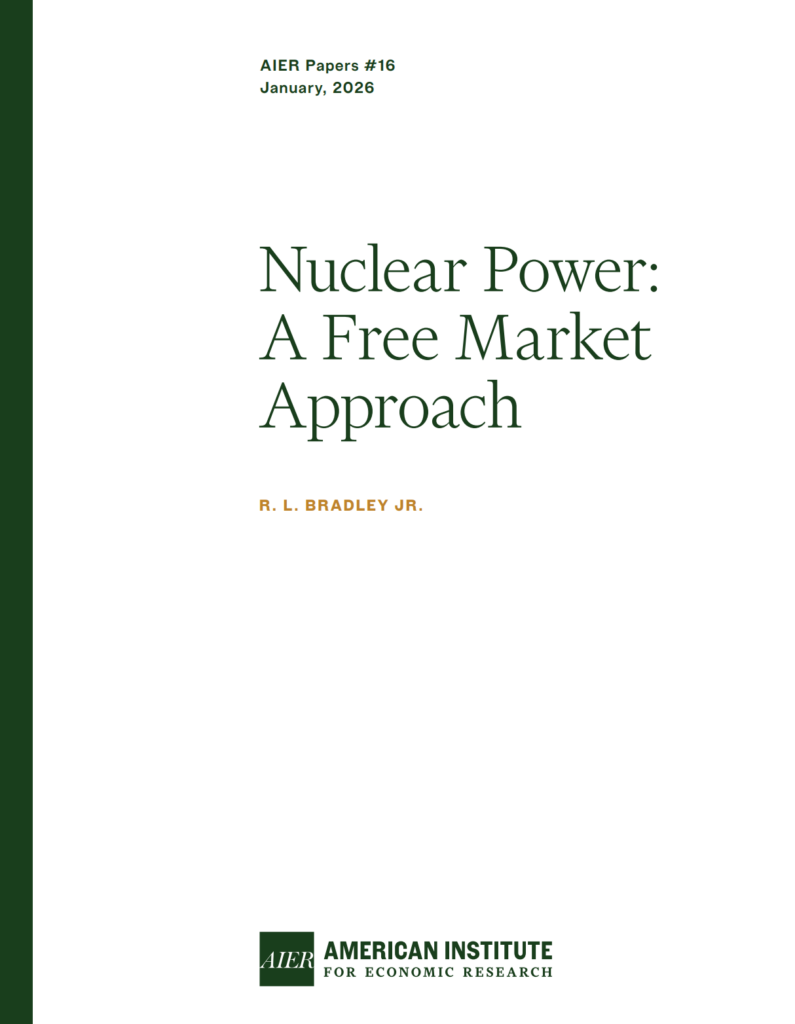
Read more from this author:  Nuclear Power: A Free Market Approach

0 comment
0
FacebookTwitterPinterestEmail

previous post
Defusing the Social Security Time Bomb 
next post
UK Enters Commercial Lithium Production with Geothermal Plant Launch

Related Posts

Defusing the Social Security Time Bomb 

February 27, 2026

Moralizing Markets: Vatican Bank Wades into Faith-Based Indexing

February 27, 2026

What Do Consumers Know That GDP Aggregates Don’t?

February 26, 2026

Capitalism’s Coalition Is Cracking — And That Should...

February 26, 2026

Business Conditions Monthly December 2025

February 25, 2026

The Old World’s Last Export

February 25, 2026

The Atlantic’s Critique of Homeschooling Ignores the Real...

February 25, 2026

A Brief History of Federal Transfers to the...

February 24, 2026

AI Regulation: A Tale of Two Austrian Economists

February 24, 2026

America Can’t Tariff Its Way Out of This...

February 24, 2026

Recent Posts

  • Lahontan Gold Eyes Resource Update as Production Nears
  • Sirios Completes Acquisition Of OVI Mining Corp
  • US-Iran Tensions Put Europe’s Gas Storage Plans at Risk
  • OTC Markets Group Welcomes RUA GOLD INC. to OTCQX
  • Brunswick Exploration Announces Appointment of Vice President – International Projects

    Master Your Money – Sign Up for Our Financial Education Newsletter!


    Ready to take your financial knowledge to the next level? Our newsletter delivers easy-to-understand guides, expert advice, and actionable tips straight to your inbox. Whether you're saving for a dream vacation or planning for retirement, we’ve got you covered. Sign up today and start your journey to financial freedom!

    Recent Posts

    • Lahontan Gold Eyes Resource Update as Production Nears

      February 27, 2026
    • Sirios Completes Acquisition Of OVI Mining Corp

      February 27, 2026
    • US-Iran Tensions Put Europe’s Gas Storage Plans at Risk

      February 27, 2026
    • OTC Markets Group Welcomes RUA GOLD INC. to OTCQX

      February 27, 2026
    • Brunswick Exploration Announces Appointment of Vice President – International Projects

      February 27, 2026
    • RUA GOLD Begins Trading on the OTCQX Best Market in the United States

      February 27, 2026

    Editors’ Picks

    • 1

      Nuvau Minerals Announces Amendment to Private Placement Terms

      February 21, 2026
    • 2

      IoT Platform Selection: Five Traps to Avoid

      February 21, 2026
    • 3

      Gold and Silver Stocks Dominate TSX Venture 50 List

      February 21, 2026
    • 4

      Top 5 Canadian Mining Stocks This Week: Belo Sun is Radiant with 109 Percent Gain

      February 21, 2026
    • 5

      Tech Weekly: Stocks Rally After SCOTUS Ruling on Trump’s Tariffs

      February 21, 2026
    • 6

      IDFC First Bank shares slump after ₹590 crore fraud disclosure

      February 23, 2026
    • 7

      Western Copper and Gold Announces Filing of Final Short Form Prospectus

      February 21, 2026

    Categories

    • Economy (13)
    • Editor’s Pick (12)
    • Investing (119)
    • Stock (37)
    • About us
    • Contacts
    • Privacy Policy
    • Terms and Conditions
    • Email Whitelisting

    Disclaimer: keepovertrading.com, its managers, its employees, and assigns (collectively “The Company”) do not make any guarantee or warranty about what is advertised above. Information provided by this website is for research purposes only and should not be considered as personalized financial advice. The Company is not affiliated with, nor does it receive compensation from, any specific security. The Company is not registered or licensed by any governing body in any jurisdiction to give investing advice or provide investment recommendation. Any investments recommended here should be taken into consideration only after consulting with your investment advisor and after reviewing the prospectus or financial statements of the company.

    Copyright © 2026 keepovertrading.com | All Rights Reserved

    Keep Over Tradings
    • Economy
    • Investing
    • Editor’s Pick
    • Stock
    Keep Over Tradings
    • Economy
    • Investing
    • Editor’s Pick
    • Stock
    Disclaimer: keepovertrading.com, its managers, its employees, and assigns (collectively “The Company”) do not make any guarantee or warranty about what is advertised above. Information provided by this website is for research purposes only and should not be considered as personalized financial advice. The Company is not affiliated with, nor does it receive compensation from, any specific security. The Company is not registered or licensed by any governing body in any jurisdiction to give investing advice or provide investment recommendation. Any investments recommended here should be taken into consideration only after consulting with your investment advisor and after reviewing the prospectus or financial statements of the company.

    Copyright © 2026 keepovertrading.com | All Rights Reserved

    Read alsox

    America Can’t Tariff Its Way Out of...

    February 24, 2026

    A Brief History of Federal Transfers to...

    February 24, 2026

    Moralizing Markets: Vatican Bank Wades into Faith-Based...

    February 27, 2026