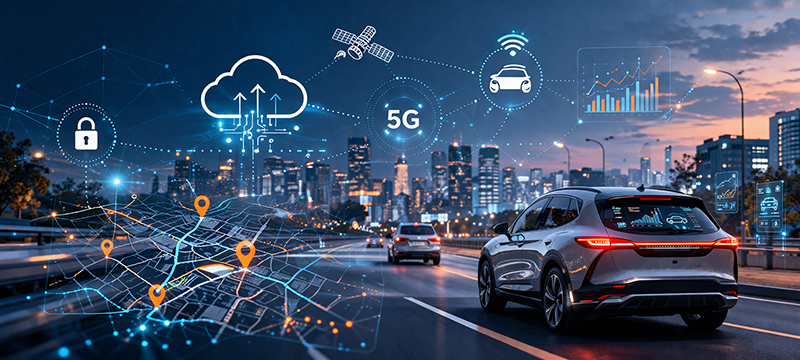
Automotive IoT has moved from a niche capability embedded in premium vehicles to a foundational layer of modern mobility systems. As vehicles become increasingly connected, they generate and consume large volumes of data that influence everything from safety systems to fleet operations and customer experiences. This evolution is reshaping how vehicles are designed, operated, and monetized across the automotive and transportation industries.
For IoT decision makers and technology leaders, understanding Automotive IoT is no longer optional. It sits at the intersection of connectivity, cloud platforms, edge computing, and software-defined architectures. The convergence of these domains is driving a transition toward connected vehicles, advanced telematics, and software-defined mobility ecosystems.
Key Takeaways
Automotive IoT connects vehicles to cloud, edge, and infrastructure systems, enabling real-time data exchange and control.
Telematics platforms are central to fleet management, predictive maintenance, and usage-based services.
Software-defined vehicle architectures decouple hardware and software, enabling continuous feature updates.
Cellular connectivity, edge computing, and standardized protocols are key enablers of scalable deployments.
Security, data governance, and system complexity remain major challenges in Automotive IoT ecosystems.
What is Automotive IoT?
Automotive IoT refers to the integration of connected sensors, embedded systems, and communication technologies within vehicles to enable data exchange with external systems such as cloud platforms, infrastructure, and other vehicles. It forms the backbone of connected vehicles, telematics solutions, and software-defined mobility services.
Within the broader IoT ecosystem, Automotive IoT acts as a mobile and distributed data platform. Vehicles are no longer isolated mechanical systems; they are networked endpoints capable of sensing, processing, and transmitting data in real time. This capability supports applications ranging from fleet optimization to advanced driver assistance and over-the-air software updates.
How Automotive IoT works
Automotive IoT systems rely on a layered architecture that combines in-vehicle hardware, connectivity networks, edge processing, and cloud-based platforms. At the core are embedded electronic control units (ECUs) and sensors that collect data related to vehicle performance, location, environment, and driver behavior.
Data generated within the vehicle is transmitted through a telematics control unit (TCU), which acts as a gateway between the vehicle and external networks. The TCU manages communication via cellular technologies such as LTE, LTE-M, NB-IoT, and increasingly 5G. In some cases, short-range communication technologies such as Wi-Fi or Bluetooth are also used for specific use cases.
Once transmitted, data is processed either at the edge or in the cloud. Edge computing capabilities within the vehicle or nearby infrastructure allow for low-latency decision-making, such as collision avoidance or real-time diagnostics. Cloud platforms, on the other hand, handle large-scale data aggregation, analytics, machine learning, and application orchestration.
The rise of software-defined vehicles introduces a new abstraction layer where software components are decoupled from hardware. This enables continuous updates, remote configuration, and the deployment of new services throughout the vehicle lifecycle.
Key technologies and standards
Automotive IoT depends on a combination of communication technologies, software frameworks, and hardware components. Key technologies include:
Cellular connectivity: LTE, LTE-M, NB-IoT, and 5G provide wide-area communication for connected vehicles.
Vehicle-to-Everything (V2X): Enables communication between vehicles, infrastructure, pedestrians, and networks.
CAN, LIN, and Ethernet: In-vehicle communication protocols connecting sensors and control units.
Telematics platforms: Systems that collect, process, and analyze vehicle data for fleet and operational insights.
Edge computing: Local data processing to reduce latency and bandwidth usage.
Over-the-Air (OTA) updates: Mechanisms to remotely update software and firmware.
Cloud IoT platforms: Infrastructure for data storage, analytics, and application management.
Standards and industry initiatives also play a key role in ensuring interoperability and scalability across Automotive IoT deployments. These include automotive-grade Linux, AUTOSAR frameworks, and emerging standards for V2X communication.
Main IoT use cases
Automotive IoT enables a wide range of applications across multiple industries, extending beyond traditional passenger vehicles.
Fleet management: Real-time tracking, route optimization, fuel efficiency monitoring, and driver behavior analysis.
Predictive maintenance: Continuous monitoring of vehicle components to detect failures before they occur.
Usage-based insurance: Insurance models based on driving behavior and vehicle usage data.
Smart logistics: Integration with supply chain systems to track goods and optimize delivery operations.
Connected public transport: Monitoring and optimization of buses, trains, and shared mobility services.
Autonomous and assisted driving: Data exchange supporting advanced driver assistance systems (ADAS).
Energy and EV management: Monitoring battery performance, charging infrastructure, and energy consumption.
These use cases demonstrate how Automotive IoT extends into industrial IoT, smart city infrastructure, and energy systems, creating interconnected mobility ecosystems.
Benefits and limitations
Automotive IoT delivers significant operational and strategic benefits. It improves visibility into vehicle performance, enhances safety through real-time monitoring, and enables new business models based on data-driven services.
Operational efficiency: Optimized routing, reduced downtime, and better resource utilization.
Enhanced safety: Real-time alerts, remote diagnostics, and driver assistance features.
New revenue streams: Subscription services, data monetization, and mobility-as-a-service models.
Lifecycle management: Continuous software updates and remote maintenance capabilities.
However, several constraints and challenges remain:
Connectivity limitations: Coverage gaps and variable network performance can impact reliability.
Latency requirements: Critical applications require ultra-low latency that not all networks can guarantee.
Security risks: Connected vehicles expand the attack surface for cyber threats.
System complexity: Integration of hardware, software, and networks increases development and maintenance complexity.
Data governance: Managing ownership, privacy, and compliance across jurisdictions is challenging.
Balancing these benefits and limitations is a key consideration for organizations deploying Automotive IoT solutions at scale.
Market landscape and ecosystem
The Automotive IoT ecosystem is composed of multiple stakeholders, each contributing to different layers of the value chain.
Automotive OEMs: Integrate connectivity and software capabilities into vehicles.
Tier 1 suppliers: Provide hardware components such as sensors, ECUs, and telematics units.
Connectivity providers: Mobile network operators and MVNOs enabling global connectivity.
Cloud and platform vendors: Offer infrastructure for data processing and application development.
Software providers: Develop operating systems, middleware, and application frameworks.
System integrators: Combine technologies into end-to-end solutions for enterprises.
The shift toward software-defined mobility is also changing competitive dynamics. Traditional automotive players are increasingly collaborating with technology companies, while new entrants focus on software platforms and data services.
Future outlook
The evolution of Automotive IoT is closely tied to advances in connectivity, computing, and software architectures. The rollout of 5G and future 6G networks is expected to enable higher data throughput and lower latency, supporting more advanced use cases such as cooperative driving and real-time vehicle coordination.
Software-defined vehicles will continue to gain traction, enabling continuous feature deployment and reducing dependency on hardware upgrades. This shift will likely accelerate the adoption of subscription-based services and new revenue models.
Edge computing will also play a larger role, particularly for applications requiring immediate decision-making. At the same time, increasing regulatory scrutiny around data privacy and cybersecurity will shape how Automotive IoT systems are designed and operated.
Overall, Automotive IoT is moving toward a more integrated and platform-driven model, where vehicles are part of a broader digital ecosystem spanning transportation, energy, and urban infrastructure.
Frequently Asked Questions
What is Automotive IoT?
Automotive IoT refers to the use of connected sensors, communication technologies, and software platforms in vehicles to enable data exchange with external systems such as cloud services and infrastructure.
What is a connected vehicle?
A connected vehicle is a vehicle equipped with internet connectivity and communication systems that allow it to send and receive data in real time.
What is telematics in Automotive IoT?
Telematics is the technology that combines telecommunications and data analytics to monitor vehicle location, performance, and usage.
What is a software-defined vehicle?
A software-defined vehicle is a vehicle where functionality is primarily controlled and updated through software rather than fixed hardware configurations.
What connectivity technologies are used in Automotive IoT?
Automotive IoT commonly uses cellular technologies such as LTE and 5G, as well as short-range communication technologies like Wi-Fi and Bluetooth.
What are the main challenges of Automotive IoT?
Key challenges include connectivity reliability, cybersecurity risks, system complexity, and data privacy management.
Related IoT topics
Edge Computing for IoT
5G and Cellular IoT Connectivity
Industrial IoT (IIoT)
IoT Security and Device Authentication
Digital Twins in IoT
Smart Cities and Urban IoT Infrastructure
The post Automotive IoT: Connected Vehicles, Telematics and Software-Defined Mobility appeared first on IoT Business News.