On February 11, the Congressional Budget Office (CBO) released its latest Budget and Economic Outlook. It made for grim reading. Deficits are historically high, totaling $1.9 trillion in 2026 and projected to grow to $3.1 trillion by 2036.
“Relative to the size of the economy, the deficit is 5.8 percent of gross domestic product (GDP) in 2026 and increases to 6.7 percent in 2036,” the report found. “Deficits averaged 3.8 percent of GDP over the last 50 years.”
As a result, “Debt held by the public rises from 101 percent of GDP in 2026 to 120 percent in 2036, well above the previous record of 106 percent just after World War II.”
The issue is not a lack of revenue. The CBO notes that federal revenues in 2026 will total 17.5 percent of GDP, slightly above the 50-year average of 17.3 percent. Revenues are projected to remain at or above that level through 2036, reaching 17.8 percent of GDP. Over this period, individual income tax receipts and remittances from the Federal Reserve are expected to rise as a share of the economy.
The problem is runaway spending.
“Outlays are large by historical standards — and growing,” the CBO reported. “They total 23.3 percent of GDP in 2026, exceeding their 50-year average of 21.2 percent” and “remain at about that level through 2028 but then grow steadily, boosted by rising spending on mandatory programs and increasing net interest costs. Outlays in 2036 are 24.4 percent of GDP.”
These mandatory expenditures are rising largely because the population age 65 and older is growing and health care costs continue to increase, driving higher spending on Social Security and Medicare.
Is Immigration a Solution? It Depends…
Immigration is often suggested as a solution for such fiscal problems in the United States and across the West generally. As these problems are driven by the growth of the share of the population aged over 65 — who, on average, receive more in government spending via programs like Social Security and Medicare than they pay in tax — an infusion of younger people from other countries is proposed to offset this.
In a recent report titled “Immigrants’ Recent Effects on Government Budgets: 1994–2023,” David J. Bier, Michael Howard, and Julián Salazar of the Cato Institute argue that “for each year from 1994 to 2023, the US immigrant population generated more in taxes than they received in benefits from all levels of government,” the scholars wrote. “Without immigrants, US government public debt at all levels would be at least 205 percent of gross domestic product (GDP) — nearly twice its 2023 level.”
This stimulated a lively debate. . Immigrants, if they work, both pay taxes and use government programs. Milton Friedman famously said that “It’s just obvious you can’t have free immigration and a welfare state,” but he did support illegal immigration on the grounds that it brought all the economic benefits without the fiscal costs. Of course, this argument collapses when states like Minnesota and cities like New York are looking to extend governments programs to illegal immigrants, too.
The Manhattan Institute’s Daniel Di Martino pushed back, arguing “No, More Immigration Won’t Fix the Federal Budget,” and Bier, in turn, has replied to that (“Manhattan Institute’s Criticisms Vindicate Cato’s Report on Fiscal Effect of Immigrants: Part 1”).
Much of this debate is, as Paul Krugman would say, “Wonkish.” Still, when Di Martino says that “there is little reason to assume that low-income immigrants are generating thousands of dollars per person for government enterprises,” he is surely correct.
The great failing of the Cato study, as with most others on this subject, is to lump all immigrants — legal and illegal, high-skilled and low-skilled — together. This obscures at least as much as it illuminates because the correct answer to the question of whether immigration will improve the public finances is this: “It depends.”
High Skills/Wages and Low Skills/Wages
An immigrant with high skills can, on average, expect a high wage. They will, generally speaking, pay more in tax than they receive in taxpayer-funded goods and services. For a low-skilled immigrant, on average, the opposite will be true.
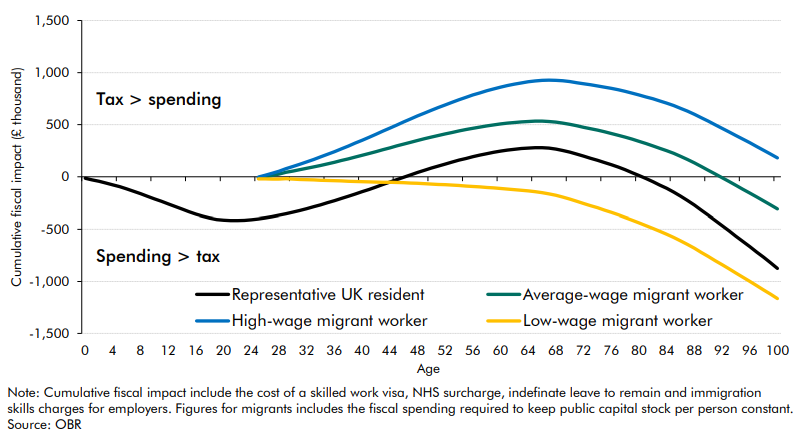
In September 2024, Britain’s Office of Budget Responsibility investigated “the cumulative fiscal impact” of immigrants of different skill levels. It found, as Figure 1 shows, that the “Representative UK resident” is a cumulative net drain on the exchequer up to their mid-40s, after which they become a net contributor until they turn 80, when they become a net drain again.
By contrast, both the “Average-wage migrant worker” and “High-wage migrant worker” are net contributors over the entirety of their lives. But, when we look at the “Low-wage migrant worker,” we see that they are a net drain on the government’s fiscal resources at every stage of their lives.
Figure 1: Cumulative fiscal impact of representative migrants
Source: Office of Budget Responsibility
None of this should be surprising, and the picture appears to be the same in the United States. In 2017, the National Academy of Sciences published a detailed report on the economic and fiscal consequences of immigration in the United States and for most of the fiscal scenarios that the report considered, low-skilled immigrants had negative effects on public finances. Indeed, so uncontroversial are — or were — such findings that in 2006 Paul Krugman wrote that: “the fiscal burden of low-wage immigrants is also pretty clear…I think that you’d be hard-pressed to find any set of assumptions under which Mexican immigrants are a net fiscal plus.”
To repeat, the correct answer to the question of whether immigration will improve the public finances or not is, “It depends.” On average, high-skilled workers will help government finances and low-skilled workers will hurt them. If immigration is to be used to alleviate the looming federal budget crisis, policymakers should focus on attracting skilled workers, and policies which would reduce this flow, such as the Trump administration’s war on H-1B visas, will make this crisis worse, or, at least, worse than it would be otherwise.
Public finances shouldn’t be the only metric considered when framing immigration policy, of course, but if that is the argument that is being made, then it is crucial that the distinction be drawn between the different impacts of different immigrants.
Lumping us all together — I am an immigrant myself — hides as much as it reveals.