Free-market capitalism still delivers the goods. But its political coalition is fracturing — and that should worry anyone who cares about prosperity and freedom.
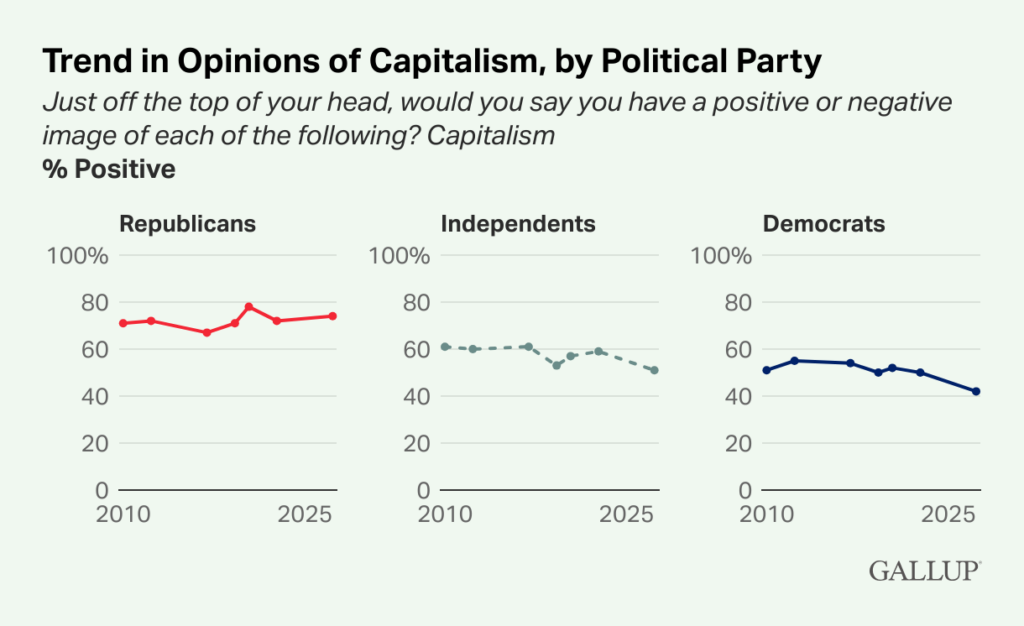
Recent Gallup polling on Americans’ views of capitalism and socialism shows that just 54 percent now view capitalism favorably, the lowest Gallup has recorded. Views of socialism remain much lower at 39 percent, but the direction matters. Support for capitalism has fallen notably over time, especially among independents and younger Americans.
The partisan breakdown is even more revealing. Republicans remain strongly pro-capitalist, though support has softened slightly. Independents now only narrowly favor capitalism. And among Democrats, fewer than half view capitalism positively, while nearly two-thirds view socialism favorably. As earlier Gallup polling on capitalism and socialism shows, this pattern has been developing for years.
Here’s the hard truth: those of us who defend free-market capitalism are unlikely to persuade most Democrats anytime soon. The data confirm it. Democrats often like the outcomes of capitalism — jobs, innovation, higher living standards — but reject the label, associating it with inequality or corporate power.
That alone wouldn’t be alarming. Political disagreement is normal. What is alarming is where capitalism is losing ground next.
A System of Liberty, Not Privilege
True capitalism is grounded in private property, competitive markets, voluntary exchange, and the rule of law. It treats individuals as decision-makers in their own lives — not subjects of top-down control. It decentralizes power, rewards value creation, and invites experimentation, allowing people to say “yes” to opportunity without asking permission from bureaucrats or politicians.
This idea is old — and proven. Adam Smith’s explanation of voluntary exchange captured it 250 years ago in The Wealth of Nations: “it is not from the benevolence of the butcher, brewer, or baker that we get our dinner, but from their regard to their own interest.” In a system of voluntary exchange, people seeking to serve themselves must first serve others. Prices convey information, profits signal value creation, and losses expose waste — the core of the price mechanism in a free-market economy.
The process isn’t perfect, but it’s far superior to the alternatives. As Milton Friedman argued in his critique of big government, markets work because they respect people’s ability to decide, adapt, and improve through cooperation — not central command.
The Real Warning in the Gallup Data
The most troubling signal in the Gallup polling isn’t Democratic skepticism. It’s the erosion among independents and younger Americans — groups that historically decide elections and shape long-term political trends.
Independents still lean pro-capitalist, but their support has fallen. Younger Americans overwhelmingly support small business and free enterprise, yet are increasingly ambivalent toward “capitalism” as a system. That suggests confusion, not rejection.
Even more concerning is what’s happening on the right.
A growing faction of Republicans — often labeled “national conservatives” or “populists” — is openly abandoning free-market principles in favor of state-directed outcomes. They argue for industrial policy, trade protectionism, expanded subsidies, and heavier regulation, all justified as necessary to achieve cultural, national, or political goals.
This matters because it breaks the traditional coalition that defended markets across parties.
When Both Sides Drift Toward Bigger Government
Gallup’s data show Americans are overwhelmingly positive toward small business (95 percent) and free enterprise (81 percent), while holding deeply negative views of big business. That gap tells us people still believe in markets — but not in a system that feels rigged and political.
The left responds by calling for more government control. Some on the right now respond by calling for different forms of government control. The mechanism is the same.
Whether it’s progressive redistribution or nationalist industrial policy, the solution offered is top-down power — politicians picking outcomes, overriding prices, and directing capital. History shows this doesn’t fix capitalism’s problems; it replaces markets with politics.
As the fallacy of corporate subsidies makes clear, once the government starts steering the economy, competition weakens, insiders win, and ordinary people lose. Bigger government doesn’t become more precise — it becomes more entrenched — regardless of which party is in charge.
Capitalism’s Problem Is Not About Performance
The Gallup results don’t show a rejection of capitalism’s benefits. They show a rejection of cronyism mislabeled as capitalism. Americans like choice, competition, small businesses, innovation, and opportunity — all products of free-market capitalism.
What they don’t like are bailouts, favoritism, barriers to entry, and rules that protect the powerful — outcomes caused by policy distortions, not markets. Policies such as occupational licensing that create barriers to opportunity or housing restrictions raise costs and block entry, especially for younger Americans. When those failures are blamed on “capitalism,” skepticism grows.
This is why the fight matters most outside the Democratic base. If independents, young people, and market-friendly conservatives drift toward bigger government — just with different slogans — the long-run prospects for freedom dim.
The Moral Case — and the Evidence
Beyond efficiency, capitalism rests on a moral foundation. Markets respect individuals’ dignity to pursue their own conception of the good life. They reward service, not status. They generate progress through experimentation and feedback. And they decentralize power, protecting against tyranny.
The evidence is overwhelming. In 1820, more than 90 percent of the world lived in extreme poverty. Today, that figure is under 10 percent, as shown by data on extreme poverty over time. Life expectancy has doubled. Child mortality has collapsed. Access to goods and services, once considered luxuries, has become common.
What drove this transformation? Not redistribution or industrial planning. It was the spread of market institutions: open trade, secure property rights, sound money, and the freedom to invest and innovate. The comparisons are instructive — East v. West Germany, North v. South Korea, Venezuela v. Chile. Where markets are embraced, prosperity follows. Where they’re suppressed, poverty and repression prevail.
Reclaiming Capitalism
The polling tells us the challenge ahead is not convincing Democrats who already favor more government. It is rebuilding confidence among the persuadable middle and preventing the right from abandoning markets in favor of control.
The path forward isn’t to redefine capitalism, but to reclaim it: restore sound money, limit government favoritism, secure property rights, open competition, and remove barriers that trap workers and families. And we must explain — not just defend — why free-market capitalism remains the best path to prosperity.
Public skepticism is rising, yet the moral and empirical case for capitalism has never been stronger.