• Economy
  • Investing
  • Editor’s Pick
  • Stock
Keep Over Tradings
Economy

Rents, AI, and Commodity Prices: What Drove State-Level Growth in 2024?

by February 20, 2026

Measuring state-level prices with adequate precision requires a lot of data collection, and there’s always a long lag between the time period measured and the release of the data. The BEA has now released its data on state-level prices and inflation for 2024, a year when US growth patterns diverged from their pandemic-era patterns.

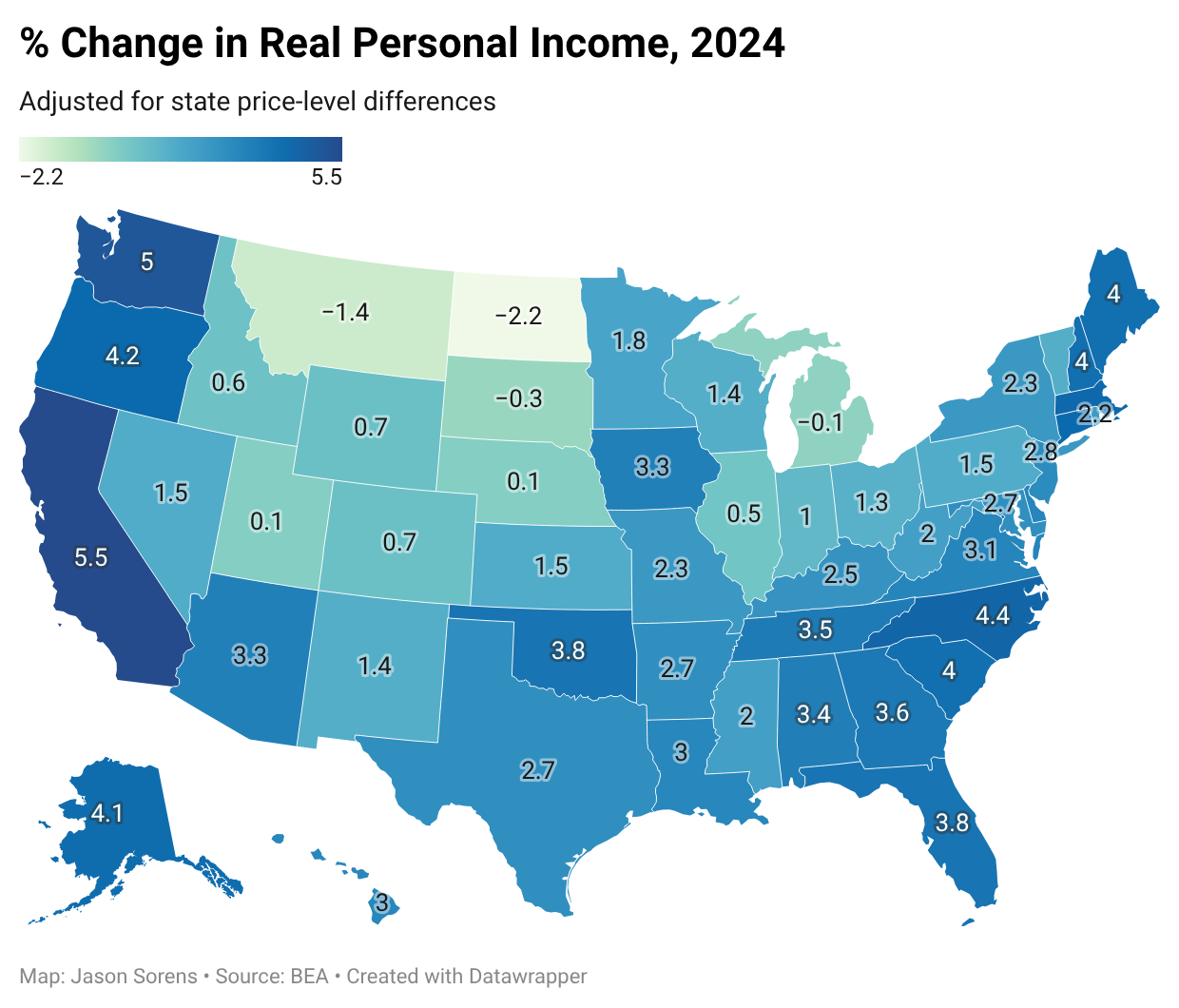
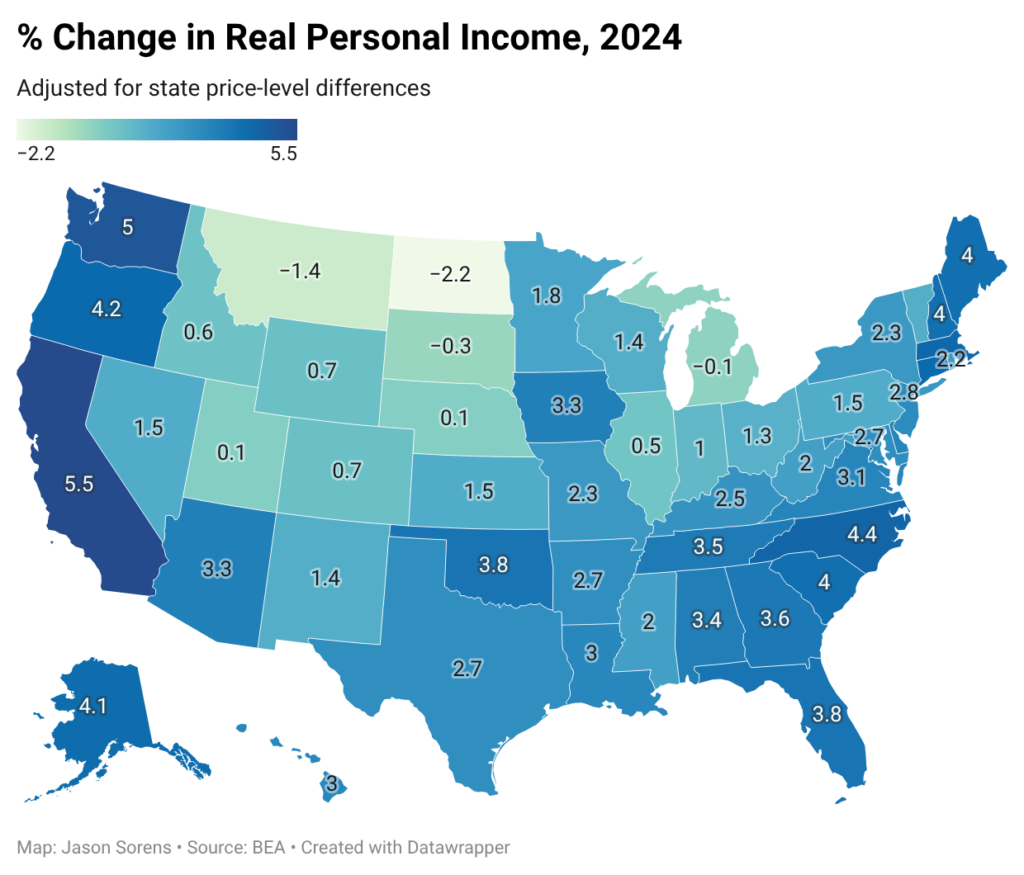
California, believe it or not, was the fastest-growing state economy in 2024, once you adjust for inflation. Typically, California has featured about average nominal growth rates and higher-than-average inflation rates, resulting in lower-than-average real growth rates. But in 2024, that longstanding pattern reversed.

Indeed, the entire Pacific Coast did well in 2024, as did much of New England and the Carolinas. The Mountain West and the Midwest suffered by comparison (Figure 1).

Figure 1: Map of State Real Personal Income Growth Rates

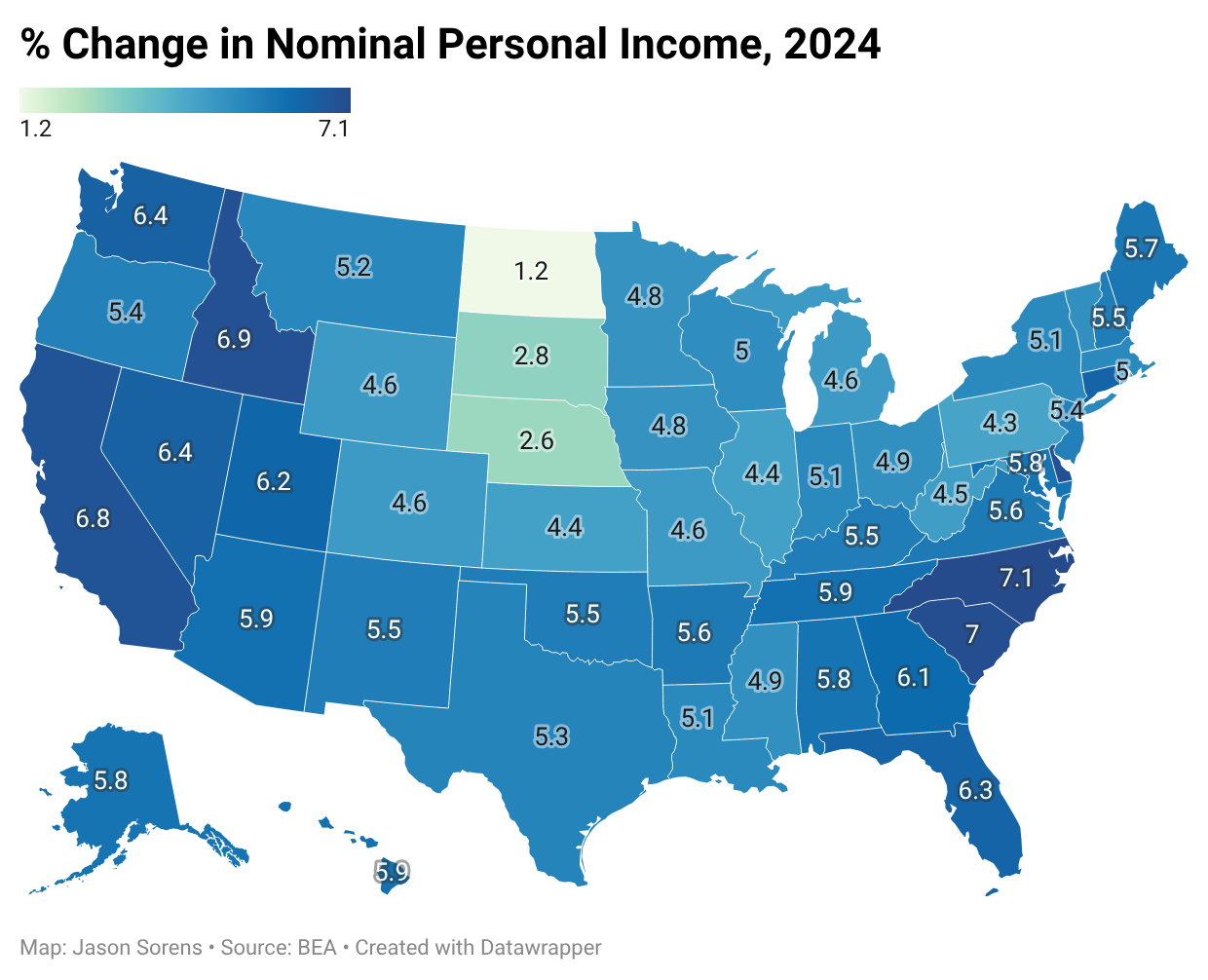
How much of the growth in the Pacific Coast and New England states came from faster nominal income growth, and how much came from lower inflation? To answer this question, let’s look at nominal growth rates first (Figure 2). The Carolinas were the fastest-growing states by nominal income, followed by Idaho and California. The Dakotas and Nebraska stand out for slow nominal income growth. Most of New England is comfortably, but not dramatically, above average.

Figure 2: Map of State Nominal Income Growth Rates

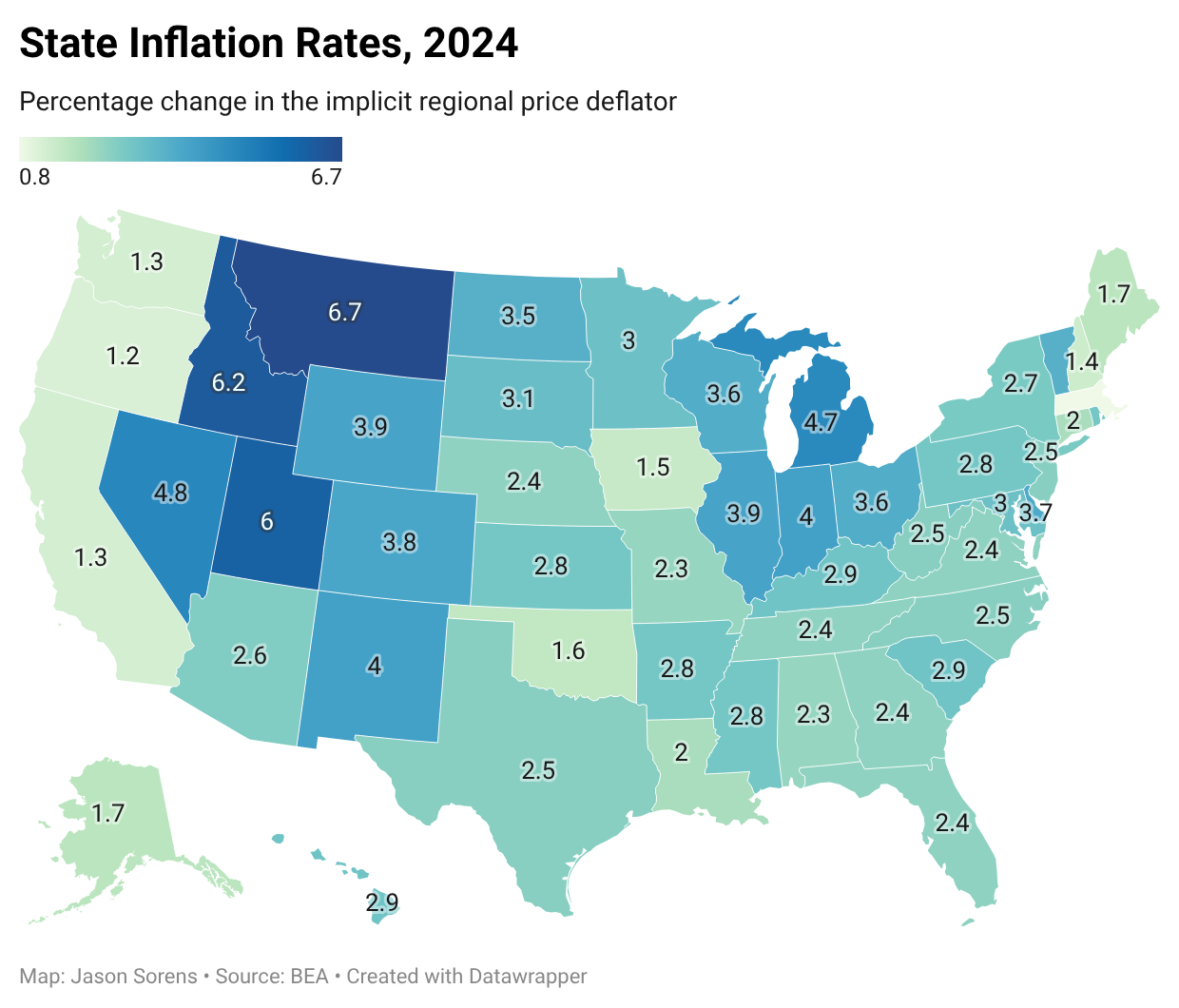
The gap between nominal and real growth rates represents inflation. But let’s map inflation on its own (Figure 3). That Massachusetts had the lowest inflation rate in the US in 2024 may be a bit of a surprise. All the Pacific states are also low, as is New Hampshire. Montana had the highest inflation in the country, followed by Idaho, Utah, and Nevada. It’s worth noting here that low-population states tend to have the biggest year-to-year swings in inflation rates. It’s not that they tend to be higher or lower, just more volatile and less predictable.

Figure 3: Map of State Inflation Rates

It’s possible that growing housing demand in the Mountain West states may be responsible for their low real growth rates. If the people moving to the Mountain West states are productive workers, we would expect nominal growth rates to rise as well. Retirees, by contrast, don’t add as much to the productive capacity of an economy.

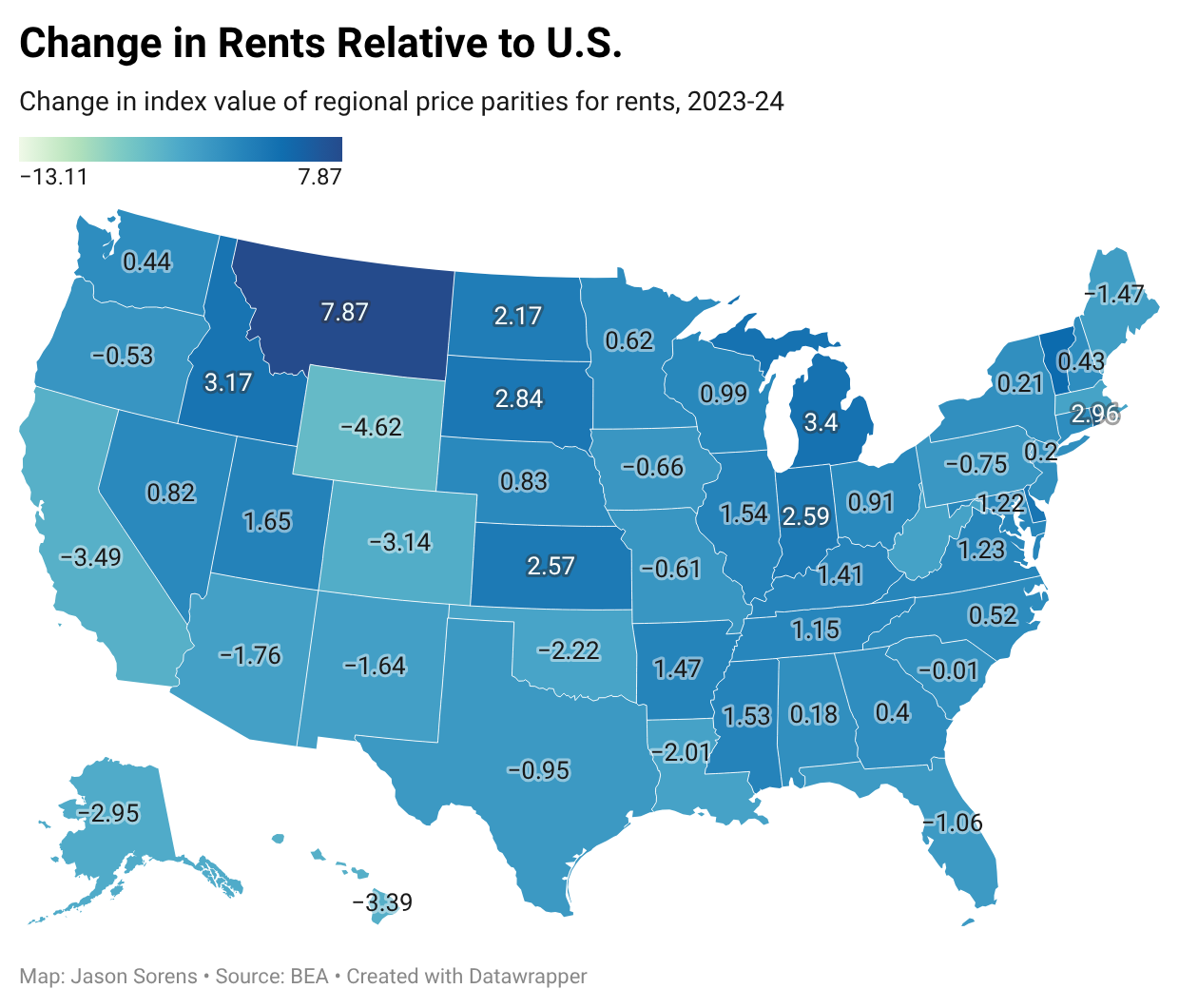
To look at the housing component specifically, I have mapped changes in state real price parities for rents in Figure 4. These numbers represent state-level change in rents relative to the US average. So a positive figure means that rents rose more rapidly in the state than in the US in 2024, and a negative figure means that rents rose more slowly in the state than in the US that year, not necessarily that they fell in absolute terms.

Figure 4: Map of State Change in US-Relative Rents

California had the third-lowest growth rate of rents in the US, after DC and Wyoming. That’s a dramatic turnaround for what is still America’s most expensive state for housing. The fact that the state maintained high nominal income growth alongside slow rental inflation implies that California’s slow rental inflation may be a result of new housing supply, rather than falling housing demand. If so, that means that the housing reforms that the state has enacted are starting to have an effect on production and rents. It’s plausible as well that the AI boom, in full swing already by 2024, had positive effects on California’s economy.

Montana had the fastest growth rate of rents in the US in 2024. Note that Montana’s famous housing reforms did not go into effect until at least September 2024, because they were under a district court injunction until then. The state’s high court upheld the reforms only in March 2025. There’s no way developers could have built that many homes between September and December 2024, even if they had filed building permit applications immediately after the injunction was lifted.

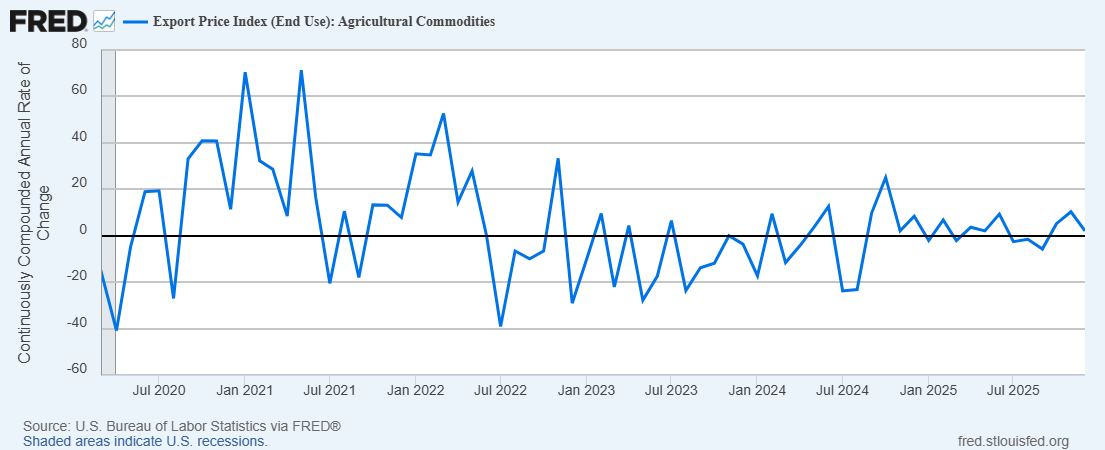
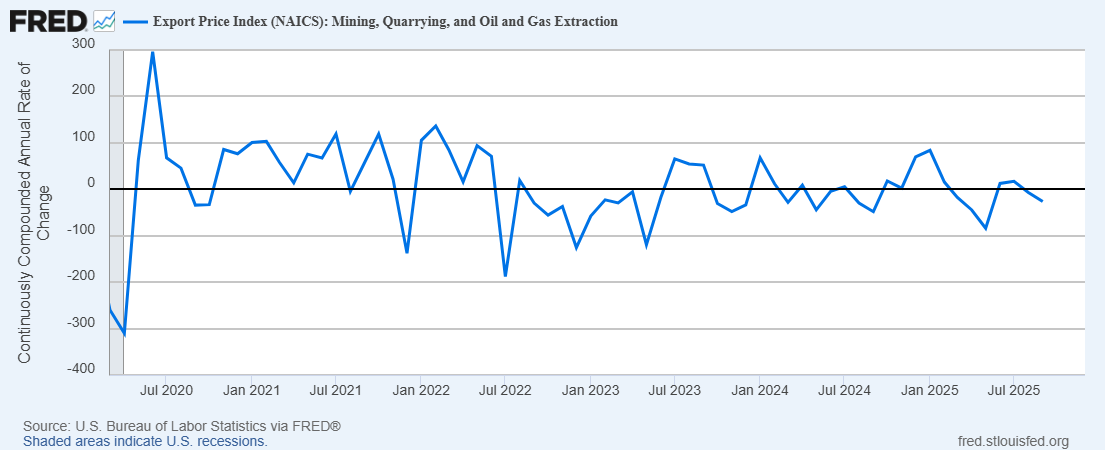
Why did the Great Plains states do so poorly? One possibility is commodity deflation. Export price indices for agricultural commodities (Figure 5) and mining, including oil and gas (Figure 6), declined after the pandemic, through 2023 and most of 2024.

Figure 5: Growth Rate of US Export Price Index for Agricultural Commodities

Figure 6: Growth Rate of US Export Price Index for Mining, Quarrying, and Oil and Gas Extraction

When the prices of commodities fall in global markets, the incomes of commodity producers tend to fall, unless they can significantly increase production. Low incomes in states reliant on commodities also impact the wages of, and demand for, local service industries. Global price fluctuations are far outside the control of state governments, but they are a fact of life for commodity producers and the firms that serve them.
It’s important not to overinterpret one year of state-level data, since these numbers can be so volatile. Over the long run, the evidence suggests that state policies that respect freedom of contract and private property rights promote real income growth. In the short run, random price fluctuations can have an outsized impact on averages. In 2024, it appears that commodity prices, the AI boom, and housing reforms (especially in California and possibly also Washington and Oregon) had a significant effect on state inflation-adjusted growth rates.

0 comment
0
FacebookTwitterPinterestEmail

previous post
No, First-Time Homebuyers Aren’t All 40 Now

Related Posts

No, First-Time Homebuyers Aren’t All 40 Now

February 20, 2026

Return to Reality: The Economy is Pivoting Amid...

February 20, 2026

Economic Data Revisions Show the Limits of Real-Time...

February 19, 2026

Indebted to the Printing Press: Fiscal Dominance Is...

February 19, 2026

The Capitalism ‘Stranger Things’ Runs On — But...

February 19, 2026

Mises and Hayek: Two Complementary Critiques of Central...

February 18, 2026

ICE’s ‘Warrant’ Shortcut Violates the Constitution

February 18, 2026

Sports Betting and the Zero-Sum Trap: How Gambling...

February 18, 2026

Are Transfers Replacing Work for America’s Poor?

February 18, 2026

Should the Fed Abandon Its 2 Percent Target...

February 17, 2026

Recent Posts

  • Rents, AI, and Commodity Prices: What Drove State-Level Growth in 2024?
  • No, First-Time Homebuyers Aren’t All 40 Now
  • Return to Reality: The Economy is Pivoting Amid Digital Overload
  • Aeris Integrates with Palo Alto Networks to Secure Wireless IoT Blind Spot
  • Steadright Critical Minerals: Advancing High-grade Mineral Assets in Morocco

    Master Your Money – Sign Up for Our Financial Education Newsletter!


    Ready to take your financial knowledge to the next level? Our newsletter delivers easy-to-understand guides, expert advice, and actionable tips straight to your inbox. Whether you're saving for a dream vacation or planning for retirement, we’ve got you covered. Sign up today and start your journey to financial freedom!

    Recent Posts

    • Rents, AI, and Commodity Prices: What Drove State-Level Growth in 2024?

      February 20, 2026
    • No, First-Time Homebuyers Aren’t All 40 Now

      February 20, 2026
    • Return to Reality: The Economy is Pivoting Amid Digital Overload

      February 20, 2026
    • Aeris Integrates with Palo Alto Networks to Secure Wireless IoT Blind Spot

      February 20, 2026
    • Steadright Critical Minerals: Advancing High-grade Mineral Assets in Morocco

      February 20, 2026
    • Rapid Critical Metals: Visit us at PDAC 2026 Convention in Toronto this March at Booth 3142

      February 20, 2026

    Editors’ Picks

    • 1

      US inflation eases more than expected to 2.4%; Fed seen staying on hold

      February 15, 2026
    • 2

      Air Canada sees surge in corporate travel as Canada diversifies trade routes

      February 15, 2026
    • 3

      28 Homes Rebuilt in a Year: Why LA’s Fire Recovery Is Stalled

      February 16, 2026
    • 4

      Nvidia stock tumbles over 2%: why investors are booking profits

      February 15, 2026
    • 5

      Micron stock plunges on Friday: has the rally run too far?

      February 15, 2026
    • 6

      Sweet Supply and Bitter Scarcity: Why Your Valentine’s Chocolates Cost More This Year

      February 16, 2026
    • 7

      Boundiali extends strike and depth at BDT3 and BST1

      February 16, 2026

    Categories

    • Economy (16)
    • Editor’s Pick (5)
    • Investing (59)
    • Stock (8)
    • About us
    • Contacts
    • Privacy Policy
    • Terms and Conditions
    • Email Whitelisting

    Disclaimer: keepovertrading.com, its managers, its employees, and assigns (collectively “The Company”) do not make any guarantee or warranty about what is advertised above. Information provided by this website is for research purposes only and should not be considered as personalized financial advice. The Company is not affiliated with, nor does it receive compensation from, any specific security. The Company is not registered or licensed by any governing body in any jurisdiction to give investing advice or provide investment recommendation. Any investments recommended here should be taken into consideration only after consulting with your investment advisor and after reviewing the prospectus or financial statements of the company.

    Copyright © 2026 keepovertrading.com | All Rights Reserved

    Keep Over Tradings
    • Economy
    • Investing
    • Editor’s Pick
    • Stock
    Keep Over Tradings
    • Economy
    • Investing
    • Editor’s Pick
    • Stock
    Disclaimer: keepovertrading.com, its managers, its employees, and assigns (collectively “The Company”) do not make any guarantee or warranty about what is advertised above. Information provided by this website is for research purposes only and should not be considered as personalized financial advice. The Company is not affiliated with, nor does it receive compensation from, any specific security. The Company is not registered or licensed by any governing body in any jurisdiction to give investing advice or provide investment recommendation. Any investments recommended here should be taken into consideration only after consulting with your investment advisor and after reviewing the prospectus or financial statements of the company.

    Copyright © 2026 keepovertrading.com | All Rights Reserved

    Read alsox

    Sports Betting and the Zero-Sum Trap: How...

    February 18, 2026

    No, First-Time Homebuyers Aren’t All 40 Now

    February 20, 2026

    Are Transfers Replacing Work for America’s Poor?

    February 18, 2026