From Predictive Maintenance to Root Cause Intelligence
For the last five years, the industrial sector has been obsessed with “listening” to machines. We have plastered billions of dollars worth of vibration sensors and thermal cameras onto motors, gearboxes and pumps. The promise of the Industrial Internet of Things (IIoT) was simple: If it vibrates, we can fix it before it breaks. But in 2026, we are realizing that this approach has a fundamental flaw. By the time a bearing starts to vibrate or a gearbox starts to overheat, the damage is already done. You are not preventing equipment failure; you are simply managing the aftermath.
The next generation of predictive maintenance (PdM 2.0) isn’t about detecting the symptoms of wear. It is about detecting the causes of wear. And more often than not, the root cause is environmental. It is the invisible grit, the microscopic dust and the intake quality that dictates the lifespan of an asset long before the first vibration alarm triggers.
The Blind Spot in the Digital Twin
The current iteration of the “Digital Twin” is incomplete. We have modeled the kinematics of the machine perfectly, but we have largely ignored the air it intakes.
This is a critical oversight. Industrial machinery, from gas turbines to precision CNC units, is incredibly sensitive to particulate contamination. A 5-micron particle entering a high-speed bearing is the catalyst that eventually causes the vibration three months later. If your IoT ecosystem monitors only vibration, you miss the opportunity for early intervention during the period before symptoms appear.
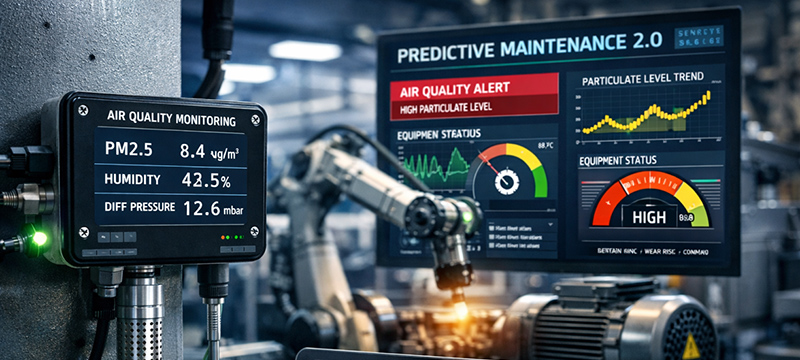
To close this gap, forward thinking facility managers are now integrating smart air management systems into their IIoT stacks. By monitoring the differential pressure and particulate load at the intake level, they can correlate air quality directly with asset performance. This shift allows leaders to maximize machine availability not just by fixing broken parts, but by ensuring the operating environment never allows the degradation to begin. This approach shifts maintenance strategy from predictive (anticipating imminent failures) to proactive (preventing deterioration before it begins).
Data-Driven “Hygiene”
The integration of filtration data into the ERP (Enterprise Resource Planning) system enables more effective scheduling of downtime.
Historically, filter changes were analog events, meaning you changed them every three months or when a red light flashed on the physical unit. In practice, this is inefficient. In a digital factory, the filtration system should be a networked node.
Imagine this: your intake sensors detect a spike in ambient particulate matter. Why? Perhaps due to a construction project next door or a change in the production line mix. A smart system doesn’t just “absorb” this. Instead, it communicates this information. It signals the Building Management System (BMS) to increase positive pressure in the clean room, or it alerts the maintenance scheduler that the filter life has dropped by 20% in a single shift.
This is where return on investment (ROI) is realized. It eliminates the “calendar-based” maintenance that wastes money on good filters, and eliminates the “failure-based” maintenance that costs money in downtime. It effectively enables a just-in-time maintenance schedule for the equipment’s air intake systems.
The Cost of Micro-Downtime
We tend to focus on catastrophic failures. The line stops that make the quarterly report. But a significant, often overlooked factor in productivity loss is ‘micro-downtime’. These are the 2-minute stops, the sensor resets and the thermal throttles that happen when electronics get dirty or intakes get clogged.
Excess heat impairs electronics, and dust accumulation increases thermal insulation, exacerbating overheating. In server rooms and control cabinets, a layer of dust on a heat sink changes the thermal conductivity, causing processors to throttle down. An AI-driven robotic arm may not be malfunctioning, but it can operate less efficiently due to controller overheating.
Connecting environmental controls to the IoT network makes this visible. You can overlay “Cabinet Temperature” with “Intake Particulate Load” on your dashboard. Suddenly, the correlation becomes obvious. Productivity losses may not be due to software issues, but rather to inadequate hardware maintenance and environmental conditions.
The ESG Connection: Energy is Data
There is a sustainability angle here that often gets overlooked in the tech discussion. A clogged machine operates less efficiently.
When an air intake is restricted, the fan motor has to work harder to pull the same volume of air. This increases the amp draw. In a facility with hundreds of air handlers and motors, this additional energy demand can contribute significantly to overall energy costs.
Smart sensors turn this into actionable data. By monitoring the airflow resistance in real-time, the system can calculate the exact energy cost of a dirty filter vs. the cost of a replacement. It can calculate the optimal time to replace consumables in order to minimize carbon footprint.
According to a report by Deloitte on the future of smart manufacturing, organizations that integrate sustainability metrics directly into their operational dashboards are seeing a marked increase in operational efficiency. Sustainability efforts now focus not only on environmental impact but also on reducing mechanical inefficiency, which is reflected in unnecessary energy consumption.
The Self-Healing Ecosystem of the Future
We are moving toward a future where the factory will be autonomous not just in production, but in self-preservation.
In the next few years, we will see “Self-Healing” environmental controls. If an IoT sensor on a laser cutter detects a rise in smoke or particulates, it won’t just log an error. It will communicate with the HVAC system to isolate that zone and ramp up extraction, protecting the neighboring machines.
Vibration sensors will continue to play an important role as a final safeguard against equipment failure. However, the primary focus of value is shifting earlier in the process – toward monitoring the quality of inputs such as air, power and coolant. By controlling these inputs through real-time data, facilities can significantly improve equipment reliability and uptime.
So, if your dashboard only reports equipment failures, it is outdated. Dashboards that identify the root causes of contamination represent the future of predictive maintenance.
The post Predictive Maintenance 2.0: Why Your Vibration Sensors Are Already Too Late appeared first on IoT Business News.